This guide provides general information as of October 2026 and is not a substitute for legal advice. Whether an advertising campaign is permitted depends on the individual case. If in doubt, have specific campaigns checked from a legal point of view.
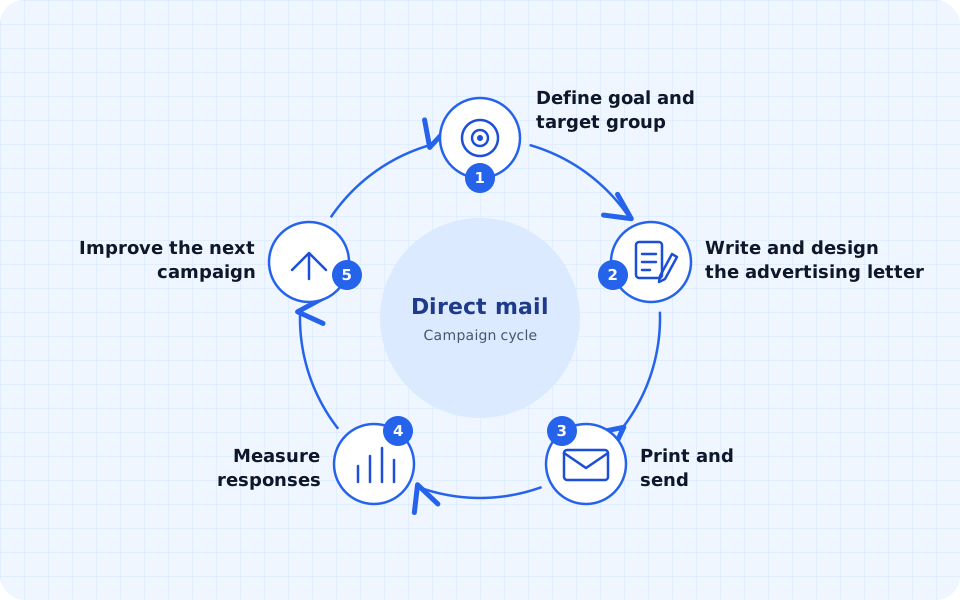
Two sets of rules apply side by side to postal advertising. The UWG (German Act against Unfair Competition) governs whether advertising is an unreasonable nuisance to the recipient. The GDPR governs whether you may process name and address for it. An advertising letter has to pass both tests. The overview direct mail shows how it fits into the whole campaign.
Data protection in postal advertising
Name and address are personal data. For the GDPR every step you take with them counts: collecting, storing, selecting for a campaign, matching against the suppression list, transmitting to a print or dispatch service provider and retaining.
As the advertising business you are the controller. A service provider that prints and sends on your behalf is generally a processor. You conclude a contract with it under Art. 28 GDPR.
The same applies in B2B as soon as the letter goes to a specific person. The name of a contact person is personal data. A letter addressed only to a company without a contact person usually does not involve personal data; for sole traders this may be different.
Possible legal bases
Consent
Under Art. 6(1)(a) GDPR, processing is lawful if the person has consented to the use of their data for a specific purpose. For advertising letters, consent is generally not mandatory. It is a good option if you want to evaluate data more extensively or if the balancing of interests would be close. You must be able to prove the consent, and the person can withdraw it at any time.
Legitimate interest
Art. 6(1)(f) GDPR permits processing that is necessary to safeguard your legitimate interests, unless the interests or fundamental rights of the data subject override them. Recital 47 of the GDPR states that direct marketing may be regarded as processing for a legitimate interest. The word “may” is important: this is not a blank cheque, and a balancing in the individual case remains necessary.
Source (in German): Regulation (EU) 2016/679 (GDPR), Art. 6 and Recital 47.
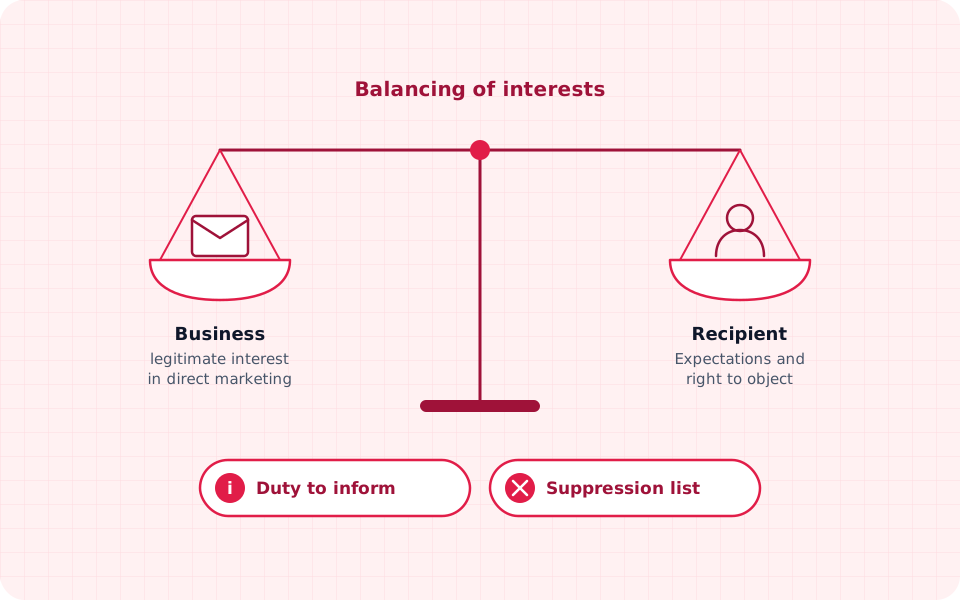
Balancing of interests
In the balancing you weigh your interest in the advertising against the interests of the recipients. These considerations typically play a role:
- Customer relationship: Recital 47 names as an example of a legitimate interest that the person is a customer of the controller. An existing relationship tends to speak in your favour.
- Reasonable expectations: Could the person foresee, when their data was collected, that you would send them advertising? A clear notice at purchase or enquiry helps.
- Type of data: Name and address are less sensitive than details on health, for example. Such sensitive data does not belong in an advertising selection.
- Origin: Data you collected yourself from a customer relationship is to be assessed differently from bought addresses.
- Time elapsed: The longer ago the last contact, the less someone still expects post from you.
- Extent of analysis: A selection by postcode or last purchase is something different from a detailed profile built from many sources. The deeper the analysis, the sooner the interests of the recipients can prevail.
Record the result in writing. If in doubt, you must be able to show why you rely on legitimate interest.
Information duties
Data collected directly
If you collect the data from the person themselves, for example with an order, Art. 13 GDPR applies. Already at the time of collection you inform them, among other things, of who is responsible, for which purposes and on which legal basis you process the data, which legitimate interests you pursue, how long you store the data and which rights the person has. Name advertising explicitly as a purpose.
Addresses from other sources
If the data does not come from the person themselves, Art. 14 GDPR applies. On top of that come the categories of data and the source they originate from, including whether it was publicly accessible. If the data is used to communicate with the person, the information must be given at the latest at the first communication with them. For an advertising campaign this is generally the letter itself.
Notice of the right to object
Under Art. 21(4) GDPR the person must be explicitly informed of their right to object at the latest at the first communication, in an understandable form and separately from other information. For advertising letters this means: the notice belongs in the letter, clearly visible and set apart, if the person has not already received it earlier.
Example of a privacy notice in the advertising letter (adapt to your case and have it checked)
Data protection: The controller is «Company name», «Address». We process your name and address to inform you about our offers. The legal basis is Art. 6(1)(f) GDPR, our legitimate interest in direct marketing. We received your address from «Source». More on this, including on the storage period and your rights: «Link to privacy policy».
Your right to object: You can object to the use of your data for advertising at any time, for example at «Email address» or «Postal address». After that you will receive no more advertising from us.
You only need the sentence on the origin if the address does not come from the recipient themselves. Whether a reference to the full privacy policy is sufficient for the other details depends on the individual case.
Source (in German): Regulation (EU) 2016/679 (GDPR), Art. 13, 14 and 21.
Respecting advertising objections
Art. 21(2) GDPR gives every person the right to object at any time to the processing of their data for direct marketing. Under Art. 21(3) you may no longer process the data for this purpose after that. Unlike the general objection under Art. 21(1), the person does not have to give reasons.
The UWG also draws a line here. Under § 7(1) UWG, advertising is not permitted if it is evident that the recipient does not want it. A further advertising letter after an objection can therefore also have consequences under competition law. Expect objections to arrive by any route: by letter, email, phone or in conversation.
This is how to handle an objection:
- Record it: Note the date and the channel it arrived by.
- Block it: Add the person to the suppression list. Name and address are usually enough.
- Check ongoing campaigns: If the address is in a selection that has not been sent yet, remove it.
- Confirm: A short confirmation creates clarity in case post that has already been printed is still on its way.
Suppression list instead of deletion
If you delete all data after an objection, the address can get back into your mailing list via a new source. That is why many businesses keep a suppression list with the bare minimum of details, against which they match every selection. If the person additionally asks for their data to be deleted, clarify in the individual case which details you may still keep for the block.
Source (in German): § 7 UWG, unreasonable nuisances; GDPR, Art. 21.
Dealing with existing customers
With existing customers the conditions are usually the most favourable: there is a relationship, and the data comes from the person themselves. Still, note the following:
- Name advertising by post as a purpose already at purchase and in the privacy policy, including a notice of the right to object.
- Advertise with offers that match earlier purchases. That is closer to what customers expect.
- Check data of customers you have not been in contact with for a long time with particular care.
- Deletion periods also apply to data you use for advertising.
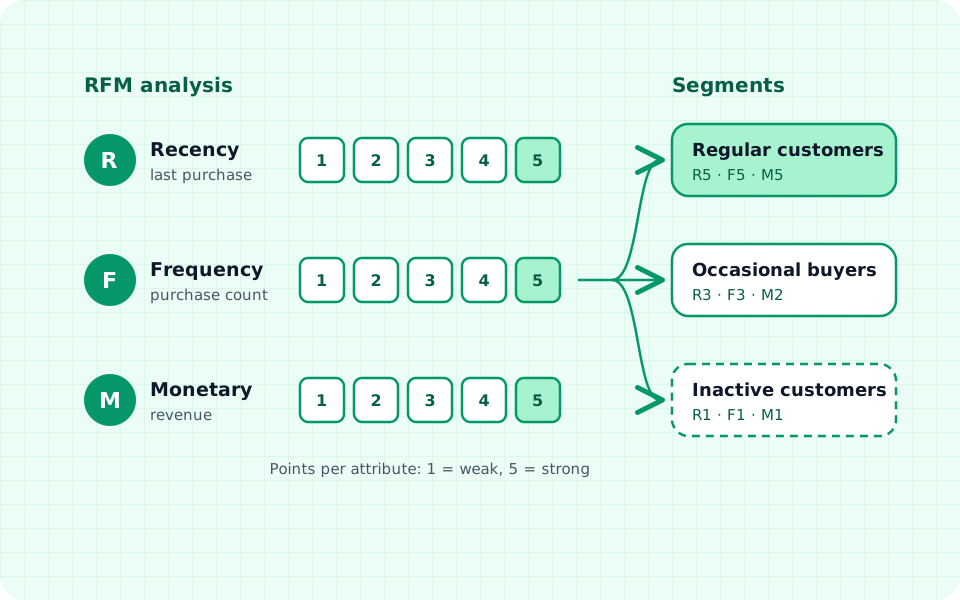
The guide direct mail target groups shows how to divide existing customers into sensible groups without evaluating more data than necessary.
Dealing with potential new customers
Publicly available business addresses
In B2B many businesses use addresses from public sources, such as the legal notice of a website. Handle them carefully. As soon as you write to a contact person by name, the GDPR rules apply. Whether there is a legitimate interest depends heavily on whether your offer fits the recipient’s activity. In the first letter you inform them under Art. 14 GDPR, including that the data comes from a publicly accessible source.
Rented or bought addresses
- Clarify the origin: How did the provider collect the data, and may it pass it on for the advertising of other businesses?
- Check the contract: Scope of use, warranties on the legal basis and the handling of objections belong in it.
- Inform: Give the details under Art. 14 GDPR in the first letter, including the source.
- Match: Match every delivery against your suppression list before dispatch.
- Clarify responsibility: If the provider sends the letters itself without you seeing the addresses, agree who fulfils the information duties.
Unaddressed advertising and letterbox stickers
Unaddressed advertising such as flyers or brochures without an address does without address data. Here competition law is in the foreground. A sticker such as “No advertising” shows that the resident does not want advertising. Anyone who puts something through the letterbox anyway generally risks a breach of § 7(1) UWG.
With personally addressed advertising letters the situation is less clear. Whether a general sticker also covers them is assessed differently and depends on the individual case, for example the exact wording. As the sender you cannot see the letterbox in any case. A clear case is an objection that reaches you directly: you must always respect it.
Practical data protection measures
- Record of processing activities: Record advertising by post as an activity of its own, with purpose, categories of data, recipients and deletion periods (Art. 30 GDPR).
- Suppression list: Keep it centrally and match against it before every dispatch, including for rented addresses.
- Deletion periods: Define how long you use data of prospects and former customers for advertising, and clear it out regularly.
- Contract with service providers: Print shops, lettershops and online dispatch services process addresses on your behalf. Conclude a data processing agreement with each of them. briefsenden.com provides it on the data processing agreement page (in German).
- Data minimisation: Pass on only the data needed for dispatch. Revenue or purchase history stays with you.
- Lean tracking: A code or QR code for the whole campaign says nothing about individual recipients. Individual codes for each recipient, by contrast, are personal data and belong in the balancing. If the code leads to a website, you generally need consent there for cookies and similar access to the terminal device that are not strictly necessary (§ 25 TDDDG, the German Telecommunications Digital Services Data Protection Act).
Source (in German): § 25 TDDDG, protection of privacy in terminal equipment; GDPR, Art. 28 and 30.
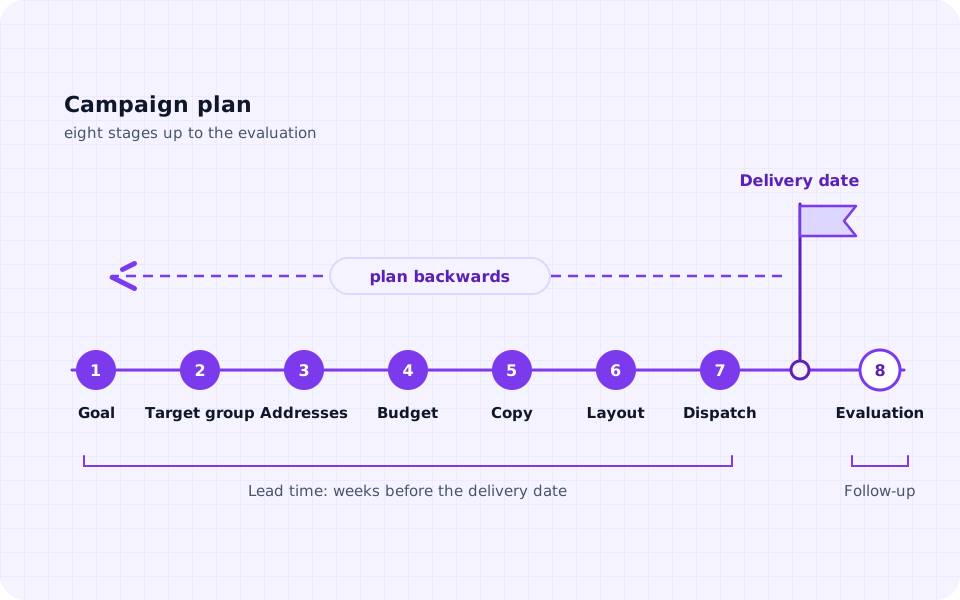
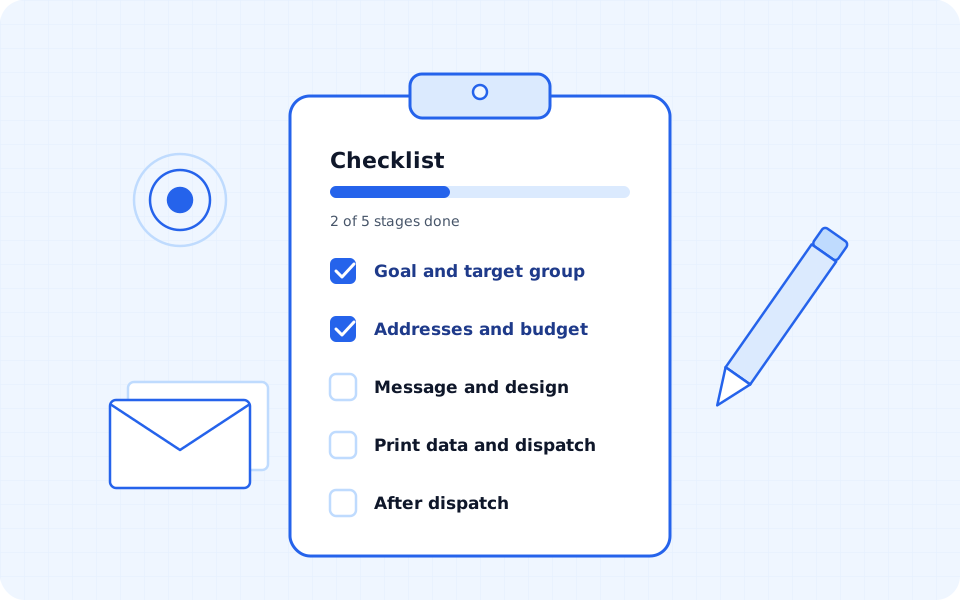
The guide planning a direct mail campaign shows where these points belong in the process. The direct mail checklist is useful for ticking them off before dispatch.
Common misconceptions
| Assumption | What is correct |
|---|---|
| Advertising letters always need consent. | The UWG requires it for email, fax, calling machines and advertising calls to consumers, not for addressed letters. You still need a legal basis under the GDPR. |
| Without a consent requirement, everything is allowed. | Balancing of interests, information duties and the right to object continue to apply. |
| The GDPR does not apply in B2B. | As soon as you write to a contact person by name, you process personal data. |
| The provider is liable for bought addresses. | You are responsible for your dispatch, including the information under Art. 14 GDPR. |
| Everything has to be deleted after an objection. | The objection ends the advertising. A suppression list helps to respect it permanently. You assess an additional request for deletion separately. |
| A privacy notice on the website is enough. | The right to object must be pointed out explicitly and set apart at the latest at the first communication. |
Sending advertising letters with briefsenden, with data protection in mind
For the processing of the recipient data on your behalf, briefsenden.com provides a data processing agreement under Art. 28 GDPR, available on the data processing agreement page (in German).
- Dispatch data only: For a mail merge, name and address in the CSV file are enough. You do not pass on attributes from your segmentation.
- Notice in the template: You put the privacy notice in your template so that it appears in every letter. In test mode you check the preview and the process without printing and without costs.
- Match the suppression list beforehand: Match the recipient list against your suppression list before uploading.
- Address book: You save regular recipients in the address book. Every address is checked against DIN 5008 before dispatch.
How briefsenden.com itself handles personal data is described in the privacy policy (in German).