Direct mail costs are easy to plan if you break them down into individual items. Some items arise once, no matter how many letters you send. Others grow with every recipient. If you separate the two, you quickly see where the money goes and where you can save.
How an advertising letter fits into the whole campaign is described in the overview Direct mail: planning and sending advertising letters.
Which costs arise with direct mail
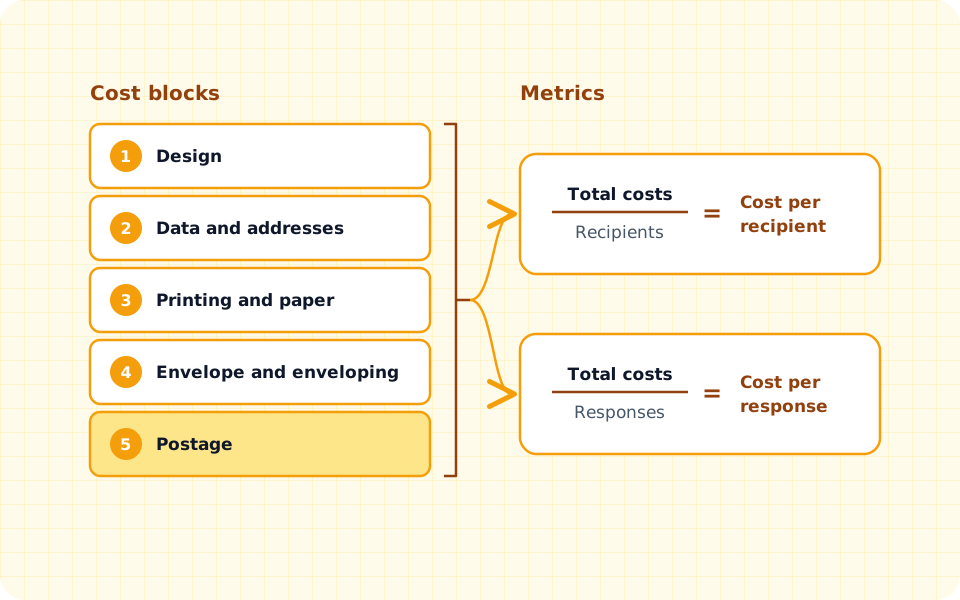
A mailing campaign usually consists of seven cost blocks:
| Cost block | What it depends on |
|---|---|
| Concept, copy and design | Own working time or external commission, number of variants, length of the letter |
| Address data | Your own customer data only cost upkeep, rented or purchased addresses cost per address and use |
| Data preparation and personalisation | Condition of the data, duplicates, number of segments, individual content per recipient |
| Printing and paper | Number of pages, colour, single- or double-sided, paper quality, print run |
| Enveloping and lettershop | Envelope format, number of inserts, machine or manual processing |
| Postage | Format, weight, tariff (standard letter or advertising tariff), print run |
| Success measurement | Effort for codes, landing page, evaluation and matching with orders |
Not every block shows up on an invoice. If you write the letter yourself or maintain the addresses in-house, you pay with working time. Count this time anyway, otherwise a campaign looks cheaper than it is.
Printing and paper costs
For printing, these factors mainly determine the price:
- Colour: Colour printing costs more than black and white. How big the gap is depends on the provider and the number of pages.
- Number of pages: Every additional page costs printing and paper. It can also lift the weight over a postage limit.
- Single- or double-sided: Double-sided printing saves sheets and thus weight, but costs a little more per sheet.
- Paper: Heavier or finished paper raises the price and the weight.
- Print run: With classic printing methods the price per piece falls with the quantity, because the set-up is incurred only once. In digital printing the unit price is more even.
With briefsenden.com the letter price depends only on the number of sheets, colour and single- or double-sided printing; with double-sided printing two pages count as one sheet. There are no set-up costs or minimum print run. A letter always costs the same number of coins, whether you send one or a thousand.
Postage: standard letter, Dialogpost and larger formats
Postage is incurred in full for every letter. Unlike the design, it is not spread across the print run. That is why it pays to choose format and tariff deliberately:
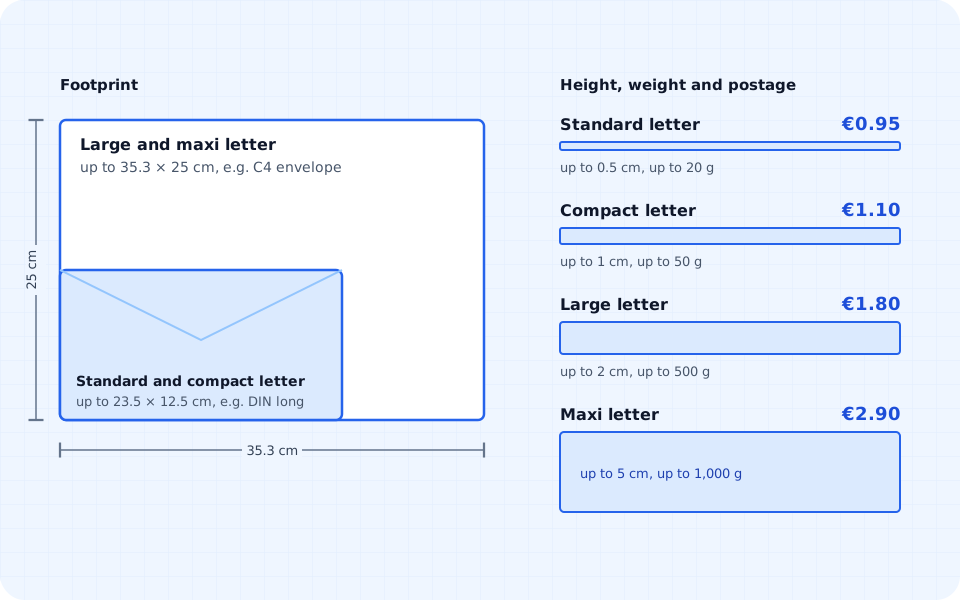
- Standard letter: In 2026 Deutsche Post charges €0.95 for a standard letter up to 20 g. It is enough for about three A4 sheets in a DIN long envelope.
- Larger formats: Compact and large letters cost more postage. Even one additional page can lift a letter into the next tier. The prices per letter type are in the guide Letter postage 2026.
- Dialogpost: The advertising tariff of Deutsche Post for larger advertising mailings. With briefsenden.com the Dialogpost postage is approx. €0.28–0.38 instead of €0.95 for the standard letter (2026), from 5,000 items per campaign. For smaller print runs you send your advertising letter as a mail merge.
Changes to prices and dimensions have been announced for 2027. If your campaign runs over the turn of the year, check the current position in the guide Letter postage 2027.
Personalisation costs
A personal salutation costs hardly more in digital printing than a letter without a name. Personalisation becomes more expensive through the effort beforehand: cleaning data, checking the salutation, generating content for each recipient.
- Name in the salutation: low effort if first and last names are recorded cleanly.
- Variants per segment: Each variant needs its own text, its own design and its own approval.
- Individual content: such as a voucher code of its own for each recipient. Here costs arise for generating the codes and for evaluating them.
With briefsenden.com the letter price does not depend on whether a letter is personalised. First and last name come from the address in the mail merge (see Personalised letters). You generate individual content beforehand yourself and upload it as a combined PDF, which is split into individual letters.
Additional services
Depending on what you take on yourself, external services are added:
- Agency or freelance copywriters and designers: for concept, copy and layout, usually as a flat fee or by effort.
- Address rental or purchase: for new-customer campaigns. With rented addresses, use is usually limited by contract, for example to one mailing.
- Lettershop: enveloping, franking, sorting and handing in to the post.
- Evaluation: matching responses with orders or enquiries, often in-house.
briefsenden.com takes care of printing, enveloping, franking and handover to Deutsche Post. You bring the copy, design and addresses yourself.
Influence of dispatch volume and format
Design and data preparation are fixed costs. They are incurred once and spread across all recipients. Printing and postage are variable costs; they rise with every letter. The table shows this with the assumed values from the sample calculation further below: €800 fixed costs and €0.96 per letter.
| Recipients | Fixed costs per recipient | Total costs per recipient |
|---|---|---|
| 500 | €1.60 | €2.56 |
| 2,000 | €0.40 | €1.36 |
| 5,000 | €0.16 | €1.12 |
The format works in the other direction: it changes the variable costs of each individual letter. With briefsenden.com the letter type depends on the number of sheets. A standard letter with up to three sheets costs from €0.91 in black and white, a compact letter with four to nine sheets from €1.28 and a large letter from ten sheets from €2.23, in each case at the best coin rate. Which format suits your message is compared in the guide Direct mail formats.
Calculating mailing costs: per recipient and per response
Three metrics make campaigns comparable:
- Cost per recipient = total costs ÷ number of recipients
- Cost per response = total costs ÷ number of responses
- Cost per sale = total costs ÷ number of sales
Define before dispatch what counts as a response: a call, an enquiry, a visit to a campaign page or a redeemed code. A sale is the purchase or order that you want to achieve with the mailing.
Sample calculation with assumed values
A specialist retailer writes to 2,000 existing customers. Except for the letter price, all values are assumed and serve only for the calculation. The letter price applies to a colour, single-sided standard letter with one sheet at briefsenden.com at the best coin rate (with a top-up from 25,000 coins).
| Item | Assumption | Amount |
|---|---|---|
| Copy and design | assumed, commissioned externally | €600 |
| Address preparation | assumed, own working time | €200 |
| Printing, envelope and postage | 2,000 × €0.96 | €1,920.00 |
| Total costs | €2,720.00 |
This results in the following, again with assumed outcomes:
- Cost per recipient: €2,720.00 ÷ 2,000 = €1.36
- Cost per response with an assumed 40 responses: €68.00
- Cost per sale with an assumed 12 sales: €226.67
Whether €226.67 per sale is a lot or a little is decided only by comparing it with the return. That is the subject of the next section.
Planning the budget
Top-down or bottom-up
With the top-down approach an amount is fixed, for example a share of the marketing budget. You work backwards to how many recipients and which format it allows. With the bottom-up approach you start from the target group: number of recipients times cost per letter, plus fixed costs. It is good to calculate both ways and to clarify the difference.
Reserve and test print run
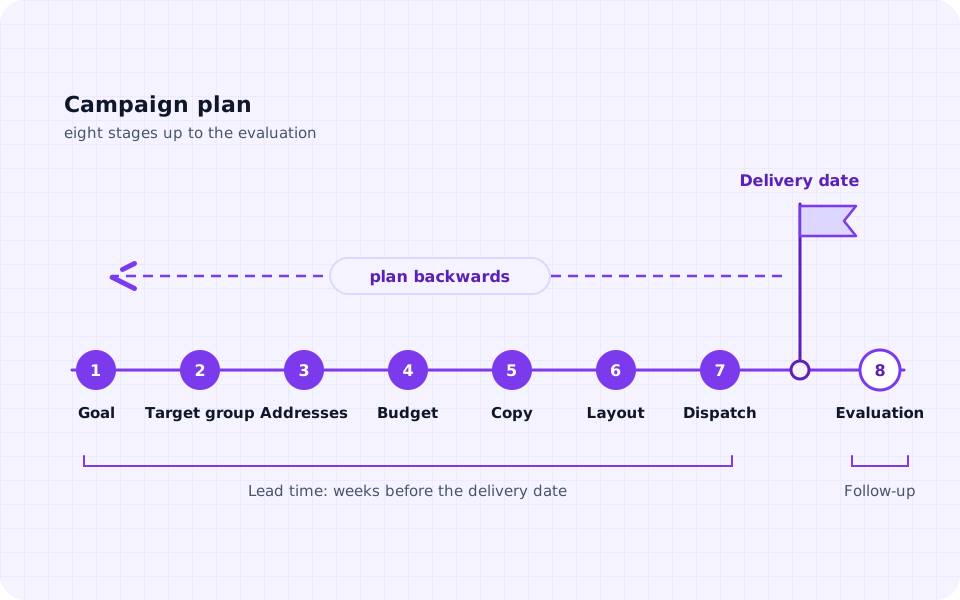
Plan a reserve for correction rounds, reprints and a second wave. With new target groups or offers a test print run helps: part of the recipients get the letter first. Only when the figures hold up does the rest follow. How to schedule the dates and steps for this is shown in the guide Planning a direct mail campaign.
Break-even: how many sales does the campaign need?
Sales needed = total costs ÷ contribution margin per sale. The contribution margin is the revenue of a sale less the cost of the goods or services.
In the sample calculation we assume a contribution margin of €250 per sale. The campaign then needs €2,720.00 ÷ €250 = 11 sales, rounded up, to cover its costs. With the assumed 12 sales, €280.00 remains. Work out the break-even before dispatch. If the figure looks unrealistically high, change the target group, the offer or the format before you print.
Assessing profitability
A mailing is profitable if the contribution margin of all sales exceeds the total costs. With existing customers it is worth looking beyond the first purchase: anyone who orders again after the mailing also brings revenue in the months afterwards. With new customers, what counts is what a new customer is worth over time.
How to attribute responses and calculate metrics such as ROI and ROAS is explained in the guide Measuring direct mail success.
Savings potential without loss of impact
- Clean up addresses: Duplicates and undeliverable addresses cost printing and postage without ever bringing a response.
- Segment instead of writing to everyone: Anyone who selects only recipients with a matching need sends fewer letters. How to do this is shown in the guide Direct mail target groups.
- Stay within the standard letter: A fourth sheet turns the standard letter into a compact letter. Rather cut the text or print double-sided than pay for the next postage tier.
- Use colour selectively: With the standard letter the surcharge for colour is small. With many pages it is worth weighing up whether every page must be in colour.
- Test first, then scale: A test print run costs little and prevents a weak variant from being printed in full.
- Dialogpost for large print runs: From 5,000 items per campaign the reduced postage of the advertising tariff is available. You send smaller print runs as a mail merge.
What an advertising letter costs at briefsenden
With briefsenden.com you upload the advertising letter as a PDF or design it in the editor. Printing, envelope, postage and handover to Deutsche Post are included in the price. A standard letter with one sheet costs, printed single-sided (each additional sheet a few coins more):
- Black and white: from €0.91 at the best coin rate, €1.64 with the smallest coin package
- Colour: from €0.96 at the best coin rate, €1.73 with the smallest coin package
You pay per letter with coins; there is no base fee. Coins do not expire, and the larger the top-up, the cheaper the coin. The calculator on the Pricing page shows what your print run costs. For personalised advertising letters with a recipient list from your spreadsheet there is mail merge dispatch, also for smaller print runs. From 5,000 items per campaign, Dialogpost dispatch with reduced postage is also available.