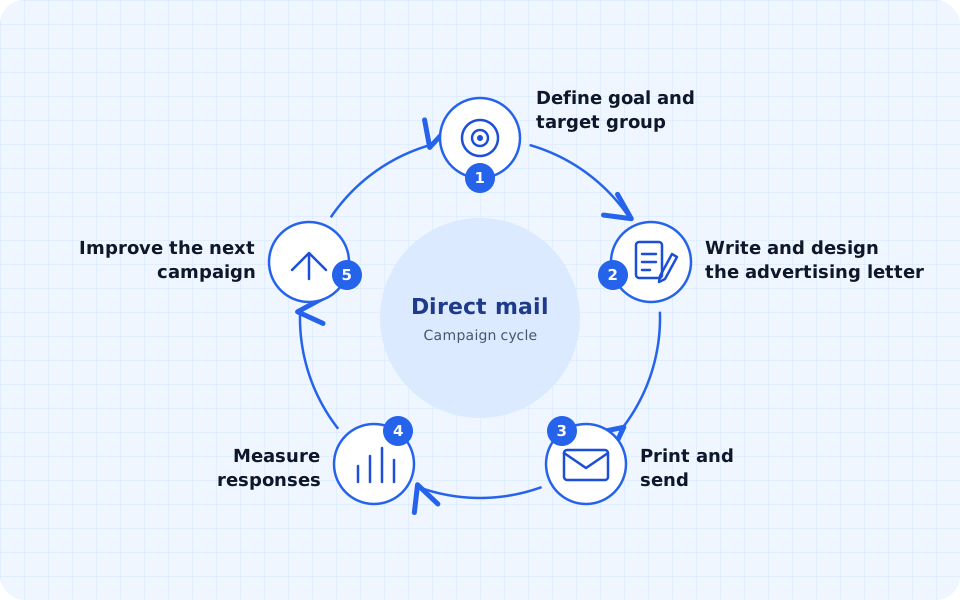
This main guide takes you from the first idea to the evaluation of your advertising letter. For practical work, you will find the specialist articles below, arranged by topic: planning, design, ideas and dispatch. Dialogpost is a dispatch rate for larger advertising print runs, not the umbrella term for all mailings.
The right guide for your next step
Planning and preparation
Define the goal and the recipients, plan the budget and take data protection into account.
Copy and design
Choose the right format, write the advertising letter and adapt a template.
Ideas and occasions
Find concrete campaign examples and the right moment for your advertising letter.
Dispatch and evaluation
Check every point before dispatch, then evaluate responses and results.
Basics: what direct mail can do
What is direct mail?
Direct mail (in German “Print-Mailing”) is a printed advertising mailing delivered by post. The “Print” sets it apart from email mailing. It is also known as direct advertising by post, postal direct marketing or letter marketing. It always means the same thing: a business addresses selected recipients directly and wants a response, such as an order, a call or a sign-up.
There are three forms, depending on the type of address:
- Addressed: Name and full address are on the item. Only this allows a personal salutation. The addresses come from your own customer base or from an address service provider.
- Partially addressed: The item carries street, house number and town but, instead of the name, a general description for the residents. This lets you reach selected streets without your own address list.
- Unaddressed: The advertising is distributed without an address to all households in an area. A personal approach and the selection of individual recipients are not possible.
Three terms are often mixed up:
- Advertising letter: a letter in an envelope with promotional content, the classic form of the addressed mailing.
- Mailing: the umbrella term for an advertising item sent to many recipients, whether a letter, a postcard or a folded item without an envelope.
- Dialogpost: not a format but a Deutsche Post rate for advertising items. It requires a minimum quantity and costs less postage than a standard letter.
Direct mail compared with digital advertising
Letters and digital channels are not mutually exclusive. The table shows the differences that matter when choosing a channel.
| Criterion | Direct mail | Email and online advertising |
|---|---|---|
| Perception | The letter is picked up, and paper and design contribute to the effect. | The message appears on a screen and is deleted with one click. |
| Environment | The letter competes with the rest of the daily post. | The message competes with newsletters, notifications and spam filters. |
| Presence | A letter can stay lying around, end up on the pinboard or be passed on. | Older messages slide down the inbox. |
| Consent | Usually not needed for addressed advertising letters; objections must be respected. | Advertising emails usually need prior consent. |
| Cost per recipient | Printing, envelope and postage are incurred for every letter. | Each additional recipient costs hardly anything. |
| Speed | Printing and delivery time need lead time. | Dispatch within minutes. |
| Measurability | Attribute responses via codes, QR code, campaign URL or phone number. | Opens and clicks are recorded technically, though not completely. |
| Personalisation | Name and salutation are simple; individual content needs preparation. | Dynamic content per recipient is easy to implement. |
In practice, combining the two pays off: a QR code or a short campaign URL in the letter leads directly to a dedicated landing page. There you can record the response to the letter.
Connecting print and digital channels
QR codes and campaign URLs connect the letter with a website. Personalised URLs (PURLs) can lead individual recipients to their own pages. Trigger-based dispatch, for example after a digital event, and individual product recommendations need prepared data and a suitable technical integration. These are general possibilities in direct marketing, not promised standard features of briefsenden. How to set up response channels and tests is explained in Measuring direct mail success.
Who postal direct marketing suits
Postal direct marketing works in consumer business as well as between companies. It fits well in these situations:
- Existing customers: You have the addresses, and the customers know you. A letter at the right occasion strengthens the relationship and prepares the next purchase.
- Regional providers: Trades, practices, retailers and service providers with a fixed catchment area reach the households near them in a targeted way.
- Offers that need explaining: A letter has room for arguments, process and terms. Anyone who is interested sets it aside and carries on reading later.
- Business customers: A letter to a contact person known by name can be passed on internally or added to the files.
- Target groups who get little post: People who manage their contracts and invoices digitally rarely receive personal letters and are more likely to notice an addressed letter consciously.
Direct mail is less suitable when the message must arrive within a few hours, when you have neither addresses nor a clearly defined region, or when the value of a response barely covers the cost per letter. How to select the right recipients and segment your customers is explained in the guide Defining direct mail target groups.
Planning: target group, budget and data protection
Planning a direct mail campaign
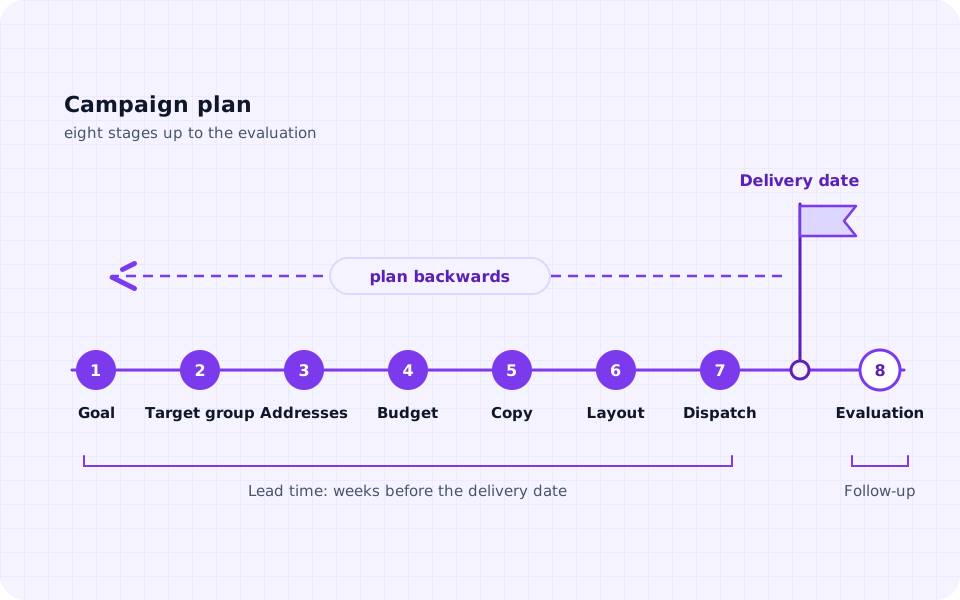
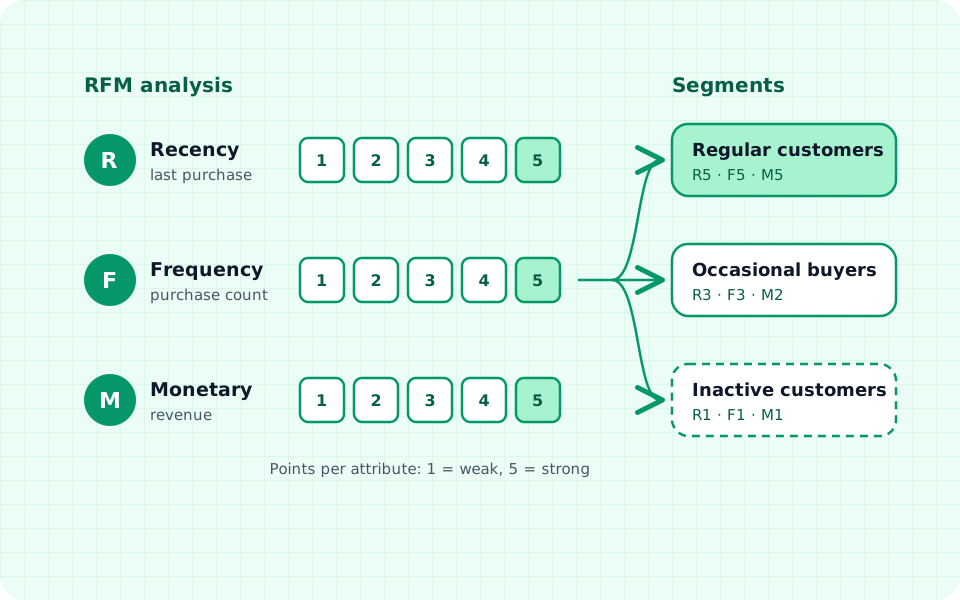
First define the goal and the recipients, then clarify addresses, budget and offer. Only after that come copy, design, testing and dispatch. The planning guide in eight steps contains the complete process including a timeline calculated backwards. The guide Target groups goes deeper into the selection and segmentation of your recipients.
Costs at a glance
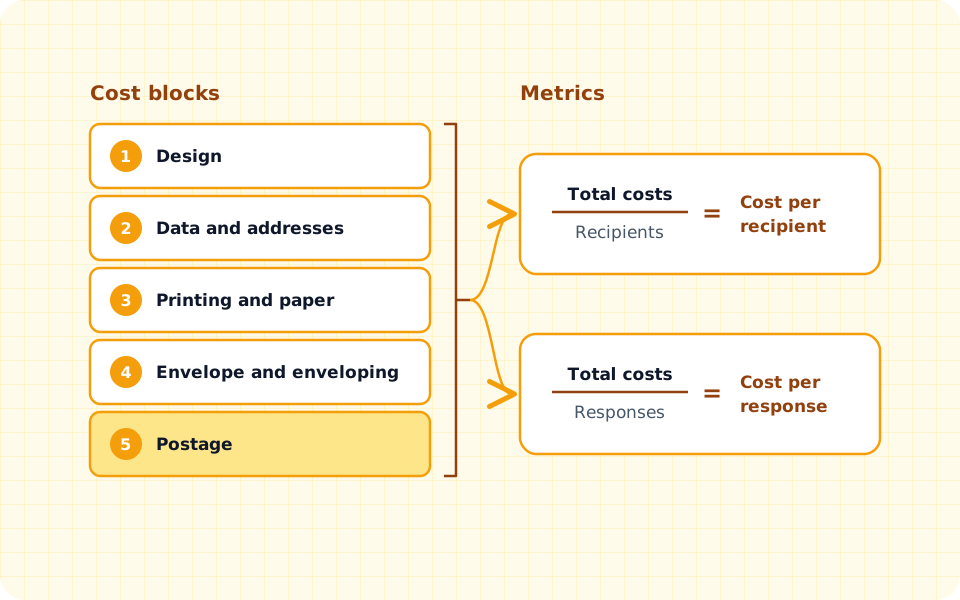
Separate one-off preparation such as design and data preparation from the costs per letter for printing, envelope and postage. Before dispatch, work out which print run your budget supports and how many sales are needed to cover the costs. Cost blocks, formulas and a complete worked example can be found under Direct mail costs.
Legal matters in brief
You need a legal basis for using the addresses. Observe information duties and advertising objections, and check the origin of third-party address sources. The legal requirements and how to handle a suppression list are explained in Advertising by post and the GDPR. There you will also find the sources and the classification for different address databases.
Design: format, copy and personalisation
Formats at a glance
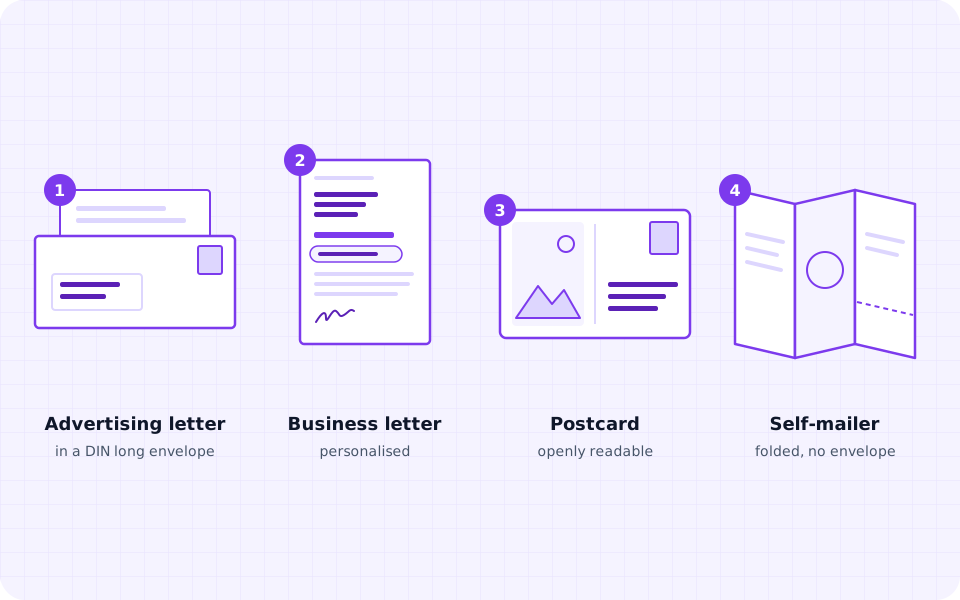
The common mailing formats differ in space, impact and effort:
- Advertising letter in an envelope: plenty of space for text, confidential, personally addressed. The recipient has to open the envelope first.
- Postcard: The message is visible immediately, but space is tight and confidential content is ruled out.
- Self-mailer: folded item without an envelope with room for images and reply parts, but more complex to print.
With briefsenden you send advertising letters in a DIN long envelope with a window, as a standard, compact or large letter depending on the number of sheets. Postcards and self-mailers are not part of the offer. The guide Direct mail formats compared compares the strengths, limits and cost factors of all formats.
Copy and design
Readers should be able to tell at a glance what benefit the offer gives them and what to do next. The structure of subject line, opening, arguments, call to action and PS is shown in Writing an advertising letter. To adapt directly, there are six advertising letter templates.
Personalisation: from the salutation to the individual offer
A personalised letter is recognisably written for this one recipient. Personalisation can be built up in stages. Each stage needs more data and more preparation:
- Name and salutation: The letter addresses the recipient by name instead of “Dear Sir or Madam”.
- Reference to the segment: Regular customers, new customers and business customers get their own variants with a fitting opening and offer.
- Individual content: The letter picks up the recipient’s last purchase, a contract or an appointment, for example with a personal voucher code.
With briefsenden you implement the first stage directly in the editor: a greeting element with the placeholders {firstName} and {lastName} takes the first and last name from the name line of the address. A salutation with “Mr” or “Ms” is not set automatically. For mail merges a neutral form such as “Dear «First name» «Last name»,” is therefore suitable. How this works in the editor and in your own PDF is shown in the guide Personalised letters.
For variants, create a separate mail merge with its own recipient list for each segment. You generate individual content beforehand, for example with the mail merge function of your word processor, and upload the result as a combined PDF. briefsenden splits it into individual letters.
Ideas: finding the right occasion
Occasions and examples
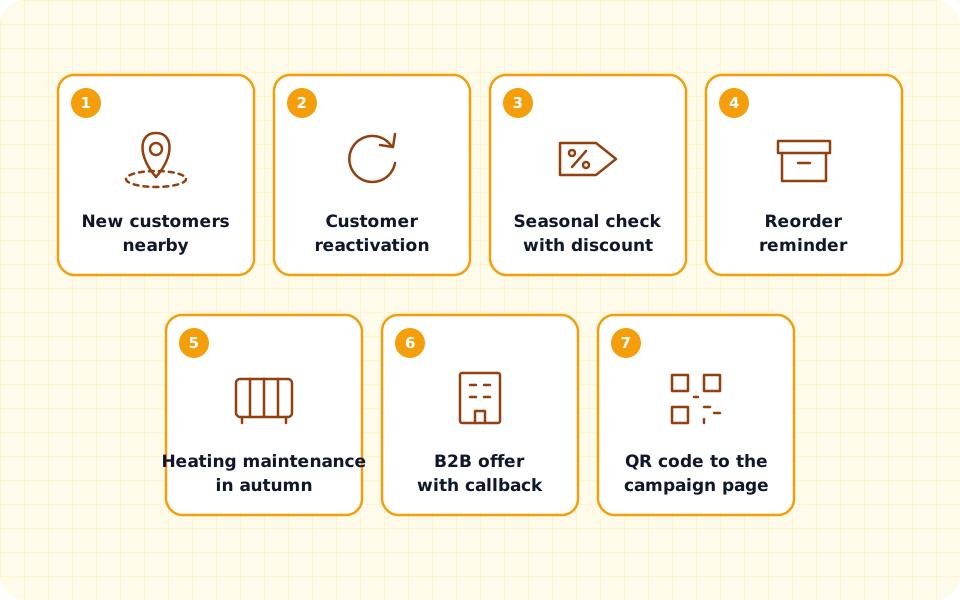
A letter without an occasion seems arbitrary. New year, start of the season, anniversary, product launch or a customer who has not ordered for a while: ideas for the whole year, including a simple annual plan, are collected in the guide Direct mail occasions.
What a direct mail campaign can look like in practice is shown by seven invented scenarios, from a craft business to an IT service provider, each with idea, implementation and measurement, in the guide Direct mail examples.
Dispatch: preparing printing and Dialogpost
Printing and dispatch
There are three ways to print and send. Which one fits depends on print run, format and your time.
| Way | Suited for | What you do yourself |
|---|---|---|
| Print and frank yourself | small print runs, simple letters | Print, fold, envelope, frank and take to the post office |
| Print shop or lettershop | large print runs, special formats, inserts | Supply print data, agree dates, observe the service provider’s minimum quantities and lead time |
| Online letter dispatch | letters in a DIN long envelope, from a single letter to a series | Upload a PDF or design it in the editor, add recipients, send |
For large advertising print runs, Deutsche Post offers the Dialogpost rate. It reduces postage but requires a minimum quantity, and the items are labelled as advertising. With briefsenden, Dialogpost is possible from 5,000 items per campaign, with postage of approx. €0.28–0.38 instead of €0.95 for the standard letter (as of 2026) and delivery in 3–5 working days. For smaller print runs, send your advertising letter as a mail merge.
The process with briefsenden: you upload the letter as a PDF or design it in the editor, add the recipients and check everything in test mode. After you send it, briefsenden prints, envelopes, franks and hands over to Deutsche Post. Letters received before 4 pm go to Deutsche Post on the same working day. You see the dispatch status in the dashboard. Standard letters have no tracking, and no fixed delivery time either. For campaign deadlines, therefore allow a buffer of a few working days.
Typical mistakes
Common stumbling blocks are outdated addresses, a deadline that is too tight, unclear response channels and unchecked links. Before approval, use the direct mail checklist. It brings together the necessary checks and saves your ticks in this browser.
Evaluation: attributing responses and learning from them
Measuring success
Define the main metric before dispatch and attribute responses via a unique response channel. Compare the results with the planned goal and budget. Formulas for response rate, conversion rate, ROI and ROAS as well as tracking and A/B tests are explained in Measuring direct mail success.
Creating direct mail and sending it online
Once your campaign is prepared, upload the advertising letter as a PDF or design it in the editor. briefsenden takes care of printing, enveloping, franking and handover to Deutsche Post. For smaller print runs, use the mail merge, for advertising campaigns of 5,000 items or more the Dialogpost wizard. Before real dispatch, you can check the preview and the process in test mode without printing and without cost.
You will find the practical guides under Mail merge with a CSV address list and Mail merge from a combined PDF. You can calculate your dispatch costs on the Pricing page.