All examples on this page are invented scenarios for illustration. They are not customer cases, and they contain no measured results.
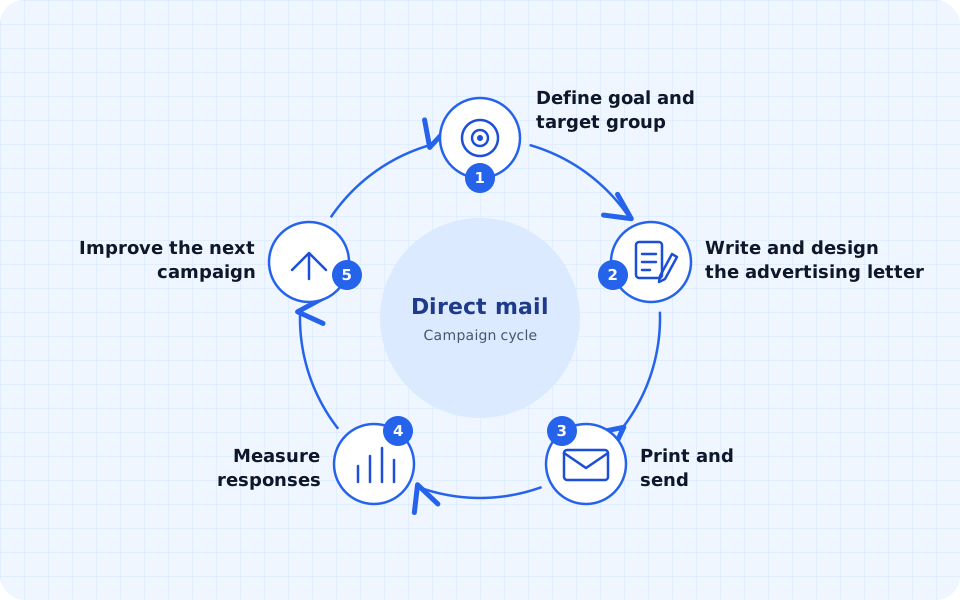
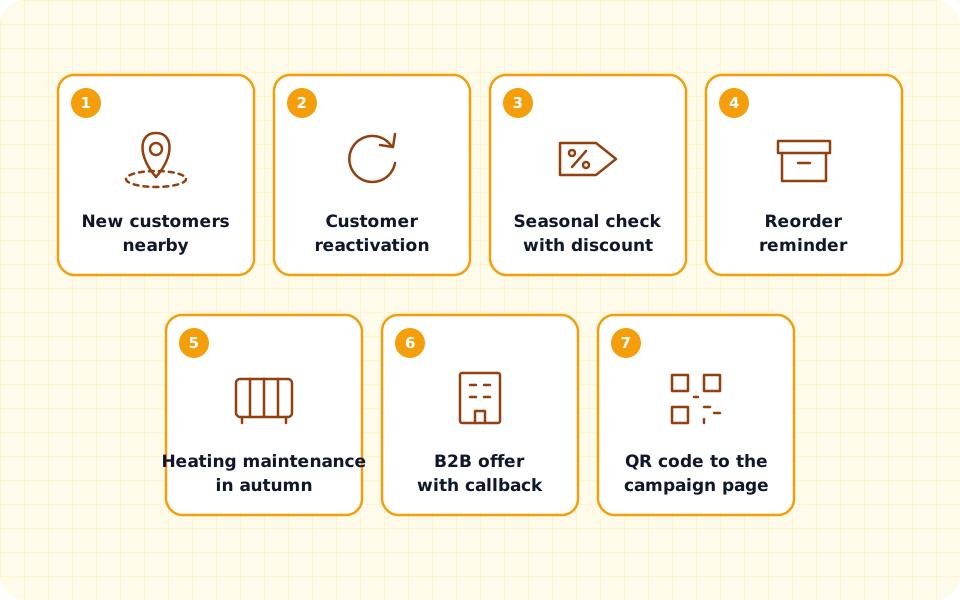
Each of the seven direct mail examples follows the same scheme: starting point, idea, implementation and what can be measured. Basics on planning, copy and dispatch can be found in the direct mail guide.
The direct marketing examples range from winning new customers through customer retention and reactivation to business customers. Read them as mailing ideas for your own industry: the mechanism behind them can often be transferred, even if your product is completely different.
Example: new customers in a new development area
- Starting point: A joinery with a workshop in town builds fitted wardrobes, hallway units and staircase balustrades. New residential areas are being built on the edge of town, and their residents do not yet know the business.
- Idea: A letter that is explicitly addressed to new neighbours. It welcomes them to the town, shows in two sentences what the workshop makes and offers a non-binding measuring appointment. Possible subject line: “Welcome to the neighbourhood: made-to-measure furniture from the workshop around the corner”.
- Implementation: The business does not know the names of the new residents. Options are a partially addressed mailing to the households in the new streets, as postal service providers offer, or rented addresses whose origin has been cleared under data protection law. The letter names a fixed contact person with a phone number and a keyword for the enquiry.
- Measurement: Enquiries with the keyword, measuring appointments arranged and later the orders from the area, compared with areas without a letter.
Example: reactivating customers
- Starting point: An online shop for office and printer supplies notices that some of its customers have not ordered for much longer than their previous rhythm would lead you to expect. These customers no longer respond to emails.
- Idea: A letter that shows what has changed since the last order, such as a wider range or faster delivery, and offers a time-limited benefit for the next order. It does not assume a reason for the break. Possible subject line: “New since your last order: what has changed with us”.
- Implementation: The shop exports the inactive customers as a CSV file and sends a mail merge with salutation by name. A promo code applies to all letters of this campaign. A randomly selected control group of inactive customers does not receive a letter.
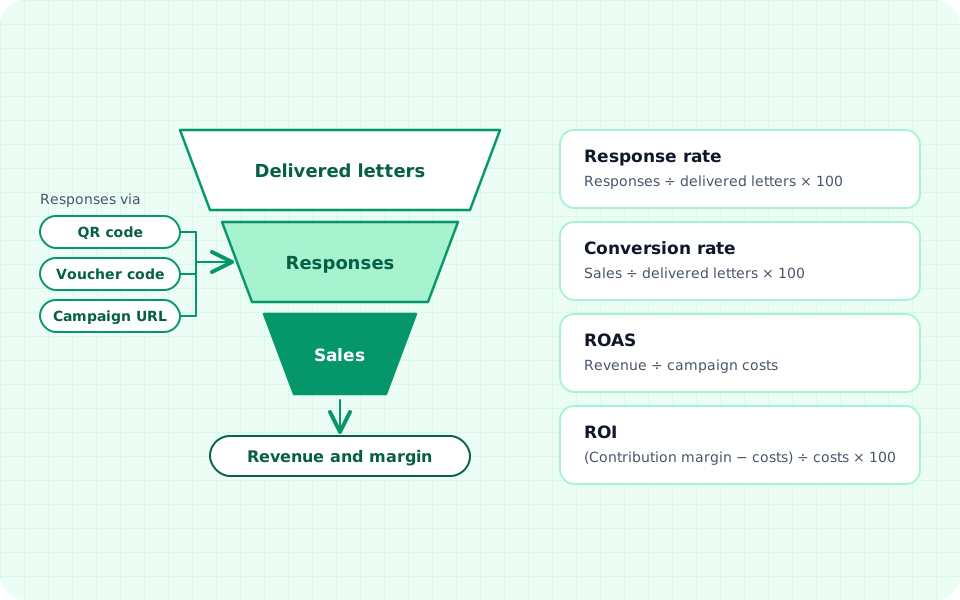
- Measurement: Orders with the promo code, the share of customers who order again compared with the control group, and the revenue per letter sent.
Example: seasonal check with a price advantage
- Starting point: A bicycle workshop has little to do in winter. As soon as it gets warmer, many customers want their bike repaired at the same time.
- Idea: A spring seasonal check at a special price for everyone who books their appointment by a fixed date before the start of the season. This spreads the work over more weeks. Possible subject line: “Ready for spring: seasonal check at a special price until «Date»”.
- Implementation: Customers from the workshop’s records of recent years are written to. The letter names the scope of the check in a few points, the price advantage, the deadline with a date and a phone number for making the appointment. It goes out towards the end of winter so that the deadline is sufficient despite the postal transit time.
- Measurement: appointments booked with the promotion keyword, the workload in the weeks before the start of the season compared with the previous year, and additional jobs that arise during the check.
Example: reorder reminder for the last purchase
- Starting point: A pet supplies retailer with a shop and an online shop sells food, litter and care products. Many customers reorder the same products at similar intervals.
- Idea: A reminder that names the most recently bought product and shortens the route to reordering. This makes the letter different for every recipient. Possible subject line: “Running low on «Product»? Your code for reordering”.
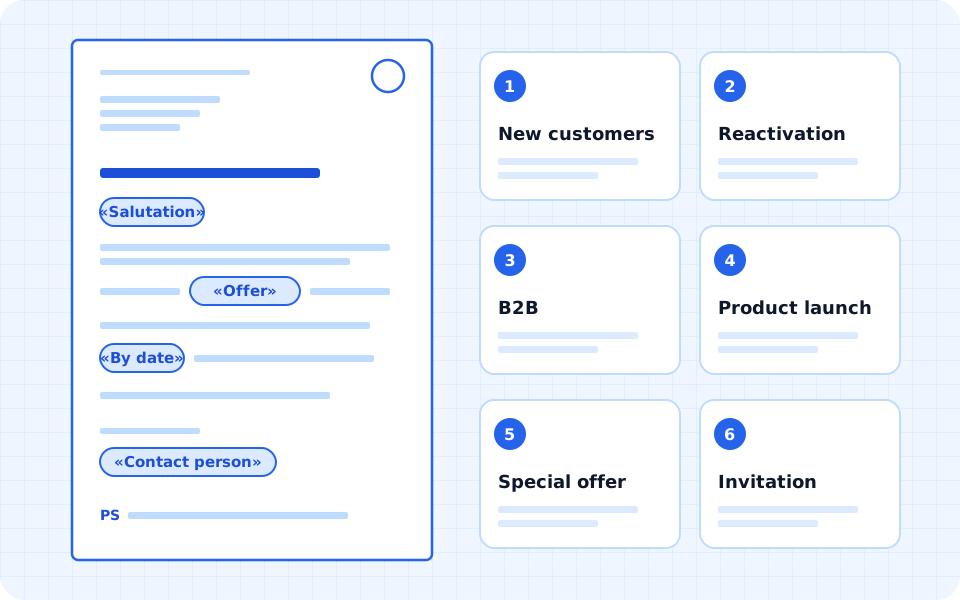
- Implementation: Because product and code change per recipient, the retailer creates the letters beforehand from its purchase data as one combined PDF, for example with the mail merge function of its word processor. Each letter names the product, a personal code and the ways to order in the shop and online. briefsenden splits the combined PDF into individual letters.
- Measurement: redeemed personal codes, reorders of the named products during the campaign period and the time between letter and order.
Example: heating maintenance before winter
- Starting point: A heating engineer looks after many systems in the region. In autumn faults pile up, and there is then hardly any time left for maintenance.
- Idea: A letter in late summer offers maintenance appointments before the start of the heating season. It briefly explains what is checked during maintenance and names fixed appointment windows. Possible subject line: “Before it gets cold: your appointment windows for heating maintenance”.
- Implementation: Customers whose last maintenance was longer ago are written to. A QR code leads all recipients to the same appointment booking page. Next to it is a phone number for everyone who prefers to call.
- Measurement: appointments booked via the booking page and by phone, the share of customers written to who have an appointment and the distribution of appointments over the weeks.
Example: B2B offer to tax advisory firms
- Starting point: A regional IT service provider wants to win tax advisory firms as customers. Firms work with confidential client data, and reliable data backup is a constant topic for them.
- Idea: A non-binding data backup check, offered by a named contact person who offers a callback at the preferred time. Possible subject line: “When did you last test your data backup?”
- Implementation: The letter goes to the head of the firm if their name is known. It names three questions the firm can check itself, such as when the last restore was tested. The sender is the contact person with a direct line. Rules also apply to advertising to business addresses, which the guide Advertising by post and the GDPR explains.
- Measurement: callback requests, checks arranged and the quotes and orders resulting from them. Because decisions in companies take time, an evaluation over several months is worthwhile.
Example: linking print and online
- Starting point: A training provider for professional development is launching new evening courses. Registration is exclusively online.
- Idea: The letter briefly presents the course programme and leads straight to the registration page via a QR code and a short campaign URL. The page picks up the image and wording of the letter so that the transition feels right. Possible subject line: “New evening courses from «Month»: view the programme and register straight away”.
- Implementation: Former participants and interested parties who had requested information are written to. QR code and URL are the same for all recipients and belong only to this campaign. For a test of two subject lines, two letter variants are created, each with its own URL.
- Measurement: visits to the campaign URL, registrations via this page and the comparison of the two variants.
Transferring an example to your business
Before you adopt an idea, check it step by step against your own situation:
- Check the occasion: Do you have a comparable reason to write that the recipient understands without explanation?
- Narrow down the recipients: Whom does the occasion really affect? A small suitable group is better than all addresses.
- Set one response: call, book an appointment or order, but only one of them.
- Build in attribution: code, keyword, campaign URL or dedicated phone number.
- Define success beforehand: Compare the cost per letter with the value of a response and decide at what point the campaign has paid off.
- Start small: first write to part of the addresses, wait for the result and then expand.
Success factors compared
What all direct mail examples have in common is a concrete occasion, a narrowly defined group of recipients and exactly one expected response. What differs is the lever that moves people to act. Each has its own pitfalls:
| Approach | Works through | What to watch |
|---|---|---|
| Regional new customers | proximity and a short route to the provider | keep the area narrow, clarify the origin of the addresses |
| Reactivation | an existing relationship | do not assume a reason for the break, form a control group |
| Time-limited price advantage | a clear reason to act now | deadline with a date, allow for postal transit time |
| Individual content | high relevance for the individual recipient | data quality, check samples before dispatch |
| Seasonal service | a need that is coming up anyway | enough lead time before the season |
| B2B with a contact person | a personal contact who can be reached | a direct line that is actually staffed |
| Print and online | a short route from the letter to the action | page for smartphones, short URL that is easy to type |
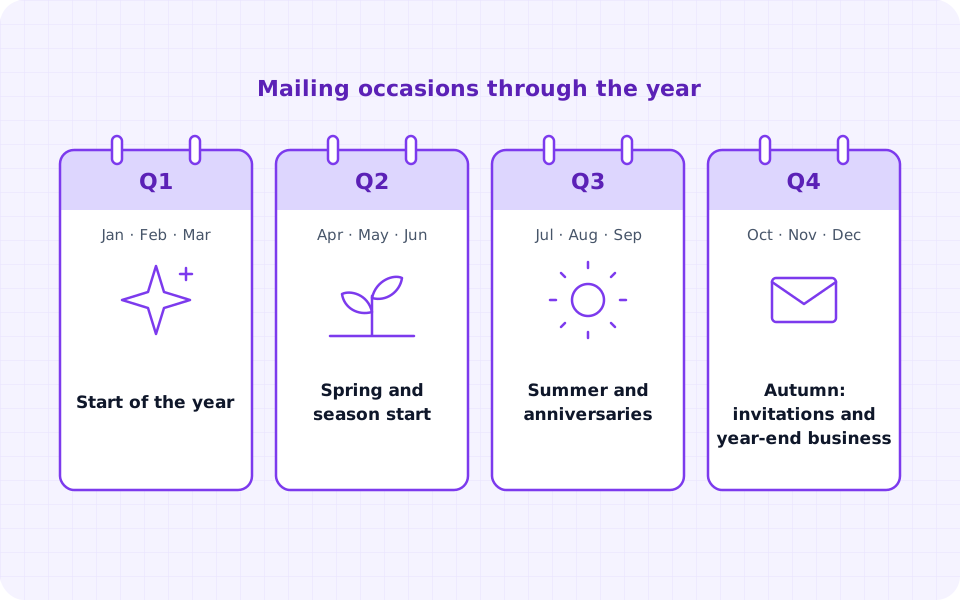
Further ideas by season and occasion are collected in the guide Direct mail occasions. How to evaluate codes, URLs and control groups is shown in the guide Measuring direct mail success.
Common mistakes
- An example is copied without transferring the occasion and recipients to your own business.
- Individual content is not checked by sampling, and wrong products end up in the letter.
- The letter promises more appointments or services than the team can offer during the campaign period.
The general checks for addresses, deadlines, codes and print data are bundled in the direct mail checklist. Rules for a clear message and call to action can be found under Writing an advertising letter.
Running your own campaign with briefsenden
Choose a scenario and first transfer target group, offer and response route to your business. The advertising letter templates help with wording. The process from preparation to approval is shown in Planning a direct mail campaign.
You can send letters in envelopes as a mail merge; for large advertising campaigns of 5,000 items or more there is Dialogpost. The limits of the available formats are explained in the format comparison.