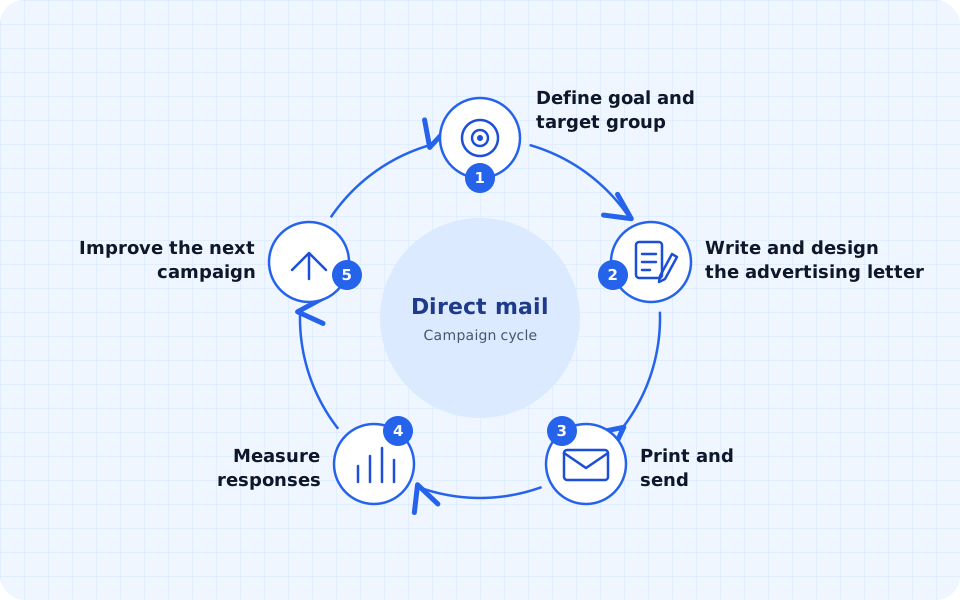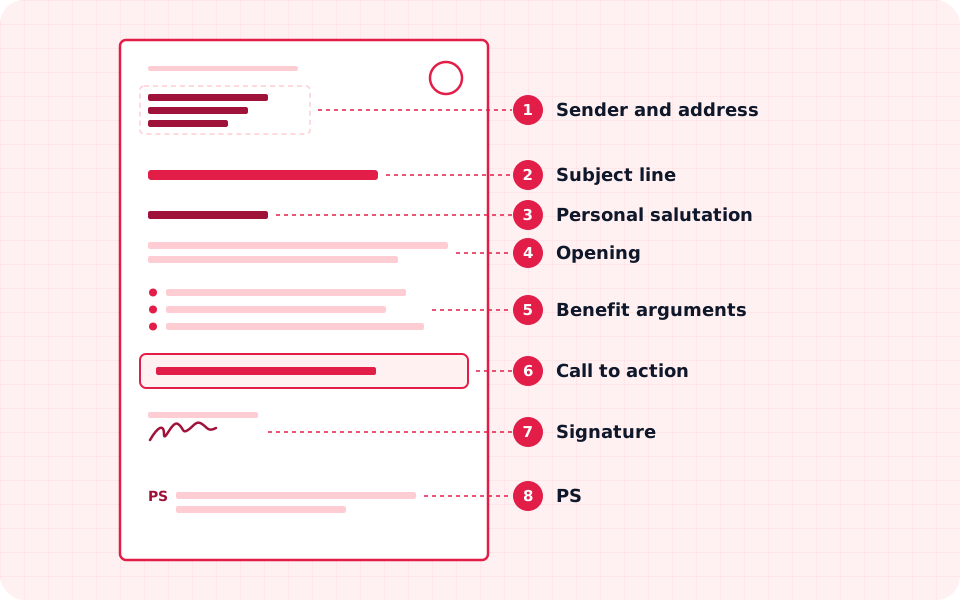
Anyone who wants to write an advertising letter often starts with their own offer. It is easier the other way round: first clarify who reads the letter and what that person gets out of it. Only then do you start writing.
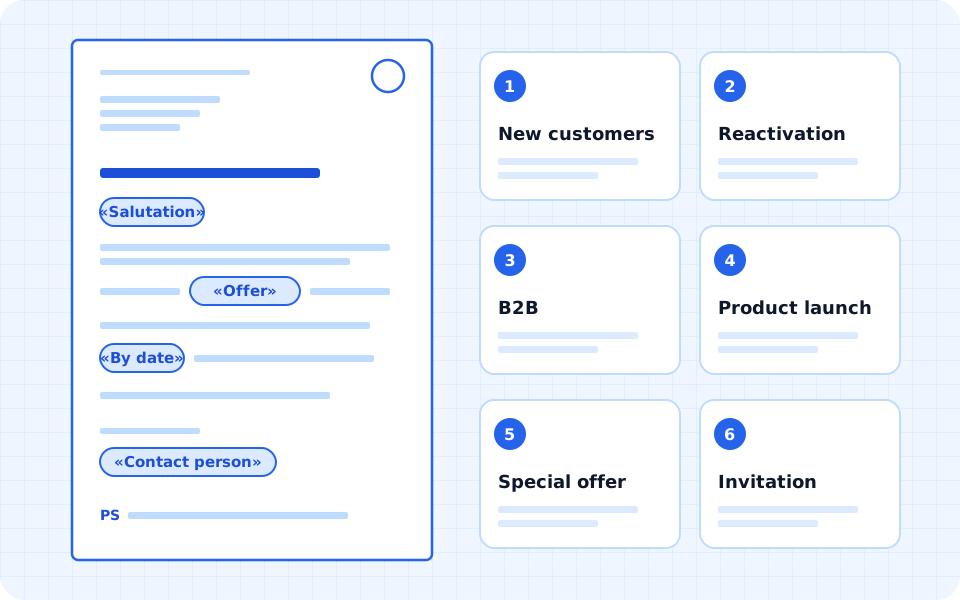
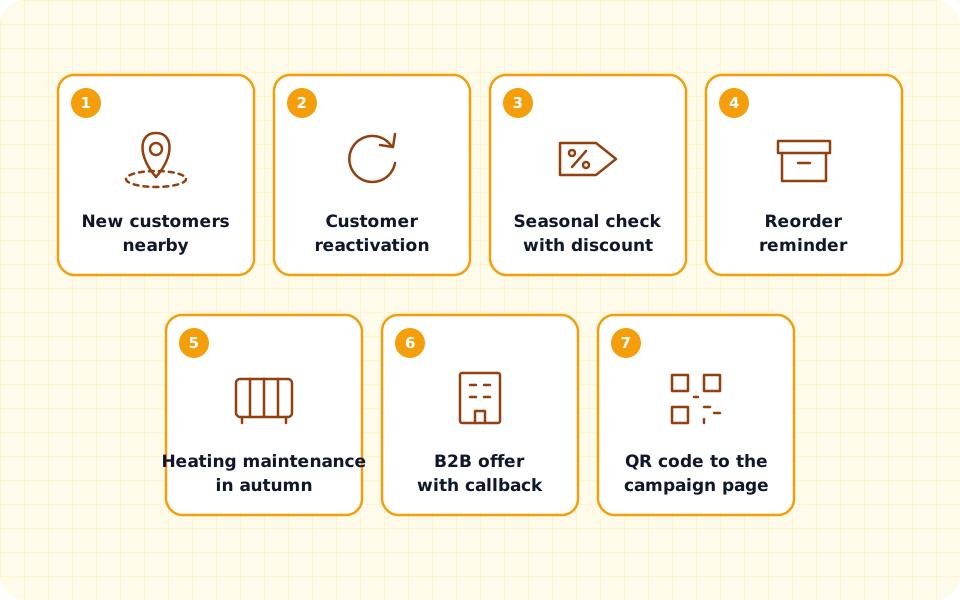
This guide goes through the letter from the subject line to the PS and uses examples to show how a weak wording becomes a better one. You will find ready-made sample letters to adapt in the advertising letter template with six samples.
What makes a good advertising letter
A good advertising letter follows three simple rules:
- One message: The letter presents one offer, not the whole range. Cut whatever does not contribute to this message.
- One reader: You write to one person, even if the same letter goes to many recipients.
- One action: At the end the reader knows exactly what to do and by when.
At first glance the recipient looks for answers to a few questions: Who is writing to me? Why me? What do I get out of it? What should I do? If they find them in the subject line, the first lines, the highlights and the PS, they keep reading. Otherwise they put the letter aside.
Target group first: who are you writing for?
Before you write the first sentence, describe your reader in a few bullet points. This picture of the reader helps with every later decision, from tone to length:
- Who is this person, and in what situation does your letter reach them?
- Which problem or wish is on their mind right now?
- What do they already know about you? Are they a customer, a former customer or do they not know you at all?
- Which objections are they likely to have?
A homeowner who has bought from you for years needs a different letter than the purchasing manager of a company who reads your name for the first time. How to divide recipients into sensible groups is explained in the guide Defining direct mail target groups.
Tone for private and business customers
| Aspect | Private customers (B2C) | Business customers (B2B) |
|---|---|---|
| Tone | personal, close to everyday life, may appeal to feelings | factual, concise, technically precise |
| Arguments | convenience, time, security, enjoyment | costs, effort, risk, processes |
| Decision | usually one person, often quick | several people involved, with review and approval |
| Next step | buy, book, drop by | conversation, appointment, request a quote |
The subject line
The subject line is set in bold above the salutation and is often the first thing the recipient reads after the sender. Under DIN 5008 it is written without the word “Betreff”. Three rules help:
- Name the benefit: What the reader gets out of it, not what you want to sell.
- Be specific: service, occasion or date instead of general advertising words.
- Keep it short: one line, without exclamation marks and without words in capital letters.
Invented examples from different industries:
| Weak subject line | Better subject line |
|---|---|
| Our new offer for you | Have your heating serviced before winter, with an appointment to suit you |
| Autumn promotion | Until 30 November: tyre change with storage at a fixed price |
| Information about our firm | Hand in receipts by smartphone instead of sorting folders |
| We have something new! | From March: lunch to take away, can also be pre-ordered |
The salutation
A salutation with a name shows that the letter is meant for exactly this reader. “Dear Sir or Madam”, by contrast, reads like a circular. If you know the name, use it.
“Ms” and “Mr” are tricky: a wrong assignment annoys more than a neutral salutation. Where you are not sure of the salutation, write “Hello «First name» «Last name»,”. That is polite and suits everyone.
If you send the advertising letter as a mail merge with briefsenden, the salutation element in the editor inserts first and last names from the address. There is no automatic distinction between “Mr” and “Ms”. Choose a neutral form such as “Hello” with first and last name instead. The guide Personalised letters shows how this works in the editor and in your own PDF.
With business customers, address a contact person wherever possible, such as the head of purchasing or the management. A letter addressed only to the company is often passed on or left lying. If you do not know a contact person, “Hello,” is friendlier than the formal collective salutation.
The opening
The first paragraph decides whether someone keeps reading. Keep it short, two or three lines at most, and start with the reader, not with yourself. Phrases such as “we would hereby like to introduce our company to you” or “we are a young, dynamic team” say nothing about the benefit.
Four ways to open well:
- The reader’s situation: “When the first night frosts arrive, time for a heating service is already running short.”
- Shared history: “Last spring you had your patio planned with us.”
- Specific question: “How many hours a month does your team spend retyping receipts?”
- Occasion: “From March our bakery will serve a lunch menu, and you should be the first to know.”
Questions only work if the reader does not answer them with a shrug and a “no”. “Would you like to save money?” is too general to work.
Benefits instead of features
A feature describes what your product is or can do. A benefit describes what changes for the reader as a result. Many advertising letters only list features and leave the translation to the reader. A simple test: put the question “And what do I get out of it?” after every feature. The answer belongs in the letter.
| Feature | Benefit for the reader |
|---|---|
| Pick-up and delivery service of the bicycle workshop | Your bike gets repaired without you having to take it to the workshop yourself. |
| Maintenance contract for the heating | You do not have to remember the appointment, the company gets in touch with you. |
| Digital receipt filing at the tax practice | You photograph receipts with your smartphone, and folders and errands are no longer needed. |
| Made-to-measure work at the joinery | The cabinet also uses the space under the sloping ceiling. |
| Interface to the accounting software | Invoice data ends up in the accounts without being retyped. |
| Evening appointments at the physiotherapy practice | You come after work and do not have to take time off. |
Word the benefit as specifically as possible. “Saves time” is weaker than “You no longer have to keep track of the appointment in your calendar yourself”.
Main body: evidence and objections
After the opening the reader wants to know whether they can believe you. Evidence makes statements verifiable:
- concrete processes: who comes when, what happens afterwards
- guarantee, return or cancellation terms
- qualifications and approvals, where available
- references and customer testimonials, but only genuine ones and with the customers’ consent
- the chance to get to know the product or service beforehand
Do not invent figures, test results or quotes. Claims that cannot be substantiated damage trust and can count as misleading advertising. A modest statement that can be checked is more convincing than a big promise.
Anticipating objections
Every reader has reasons not to respond. Name the obvious ones yourself and answer them briefly:
- “Too expensive”: put the price in context, for example against the follow-on costs of the problem, or offer a smaller way in.
- “No time”: show how little effort the first step takes.
- “Switching is a hassle”: explain what you take off the customer’s hands.
- “Never heard of you”: give evidence and offer a no-obligation first contact.
Reducing the risk
The smaller the risk, the easier it is to respond. Typical means are a free initial consultation, a no-obligation quote, a trial appointment or a simple right of return. You must also be able to keep what you promise.
The call to action
The call to action tells the reader what to do next. It comes at the end of the main body and may be highlighted visually. Four points make it clear:
- One action: make an appointment, order or drop by. Two ways of getting in touch for the same action are fine, three different requests are not.
- Specific: “Book your service appointment” instead of “Get in touch if you are interested”.
- With a deadline: a date instead of “soon”. Allow for postal transit time so that the reader has enough time.
- Easy route: a phone number with a contact person, a short campaign URL or a QR code that leads directly to the right page.
An example: “Call us by 14 November. We will give you two free appointments to choose from.” Dedicated phone numbers, promotion codes or campaign URLs also help later with the evaluation. How that works is explained in the guide Measuring direct mail success.
The PS
The PS stands set apart below the signature and therefore easily catches the eye when skimming. Use it for a thought that encourages action:
- Repeat the deadline: “PS: We allocate the appointments before Christmas in the order of the calls.”
- Mention a small extra: “PS: Anyone who books by 30 November also gets storage of the summer tyres.”
- Personal touch: “PS: I will be there myself at the first appointment. Ask me anything you would like to know about the changeover.”
A PS is short and does not open a new topic. Several postscripts weaken each other.
Design and readability
Anyone designing an advertising letter should above all make reading easy. Good design hardly stands out, bad design puts people off.
- Short paragraphs: three to five lines, with a blank line in between. The first paragraph is the shortest.
- Sparing emphasis: bold only for a few key passages such as the offer and the deadline. Underlining, capital letters and many colours look restless.
- Typeface: an easily legible typeface in at most two sizes. For body text, 11 or 12 point is usual.
- Ragged right: left-aligned instead of justified. In narrow columns, justified text opens large gaps between the words.
- White space: margins and spacing make the letter look calm. A page filled to the edge looks tiring.
- Colour and images used deliberately: logo, one accent colour and at most one image that shows the product or people.
- Keep the address field free: In an envelope with a window, the address field under DIN 5008 is visible. Only the address goes there, no logo and no advertising text.
- Signature: one signature, as an inserted image in the printed mail merge letter, with name and function in print below it. That way the reader sees who is behind the letter.
One page is usually enough. If an offer that needs explaining requires more space, a second page is fine as long as every paragraph adds something new.
Common wording mistakes
These patterns weaken many advertising letters. The right-hand column shows how to be more specific:
| Weak | Better |
|---|---|
| We would hereby like to introduce our company to you. | Your heating needs servicing before winter. We will come at a time that suits you. |
| We are the leading provider in the region. | We take care of planning, delivery and installation from a single source. |
| Benefit from our attractive terms. | Setting up costs you nothing, and you can cancel monthly. |
| Our innovative solution offers numerous advantages. | You record working hours on your smartphone, and the billing is generated from them automatically. |
| The servicing is carried out by our technicians. | Our technicians service your system. |
| Our offer is limited in time. | The offer is valid until 30 November. |
| We would be delighted if you got in touch at some point. | Book your appointment by 14 November by phone or online. |
| If you have any questions, we are always happy to help. | Our customer service answers your questions directly on the phone. |
Before-and-after example
A regional heating company wants to win homeowners in its area for a service. This is what the first draft looked like:
Before
Dear Sir or Madam,
we would hereby like to introduce ourselves to you as a competent partner for heating technology. Our company has many years of experience and a qualified team. We offer servicing, repair and modernisation of heating systems of all kinds. If you are interested, we are always happy to help.
And this is the revised version:
After
Hello «First name» «Last name»,
if the heating fails in January, it gets cold quickly, and tradespeople’s appointments are scarce by then. With a service in autumn we check the burner, pressure and valves while there is still time for a repair.
Book your service appointment by 14 November by phone or via the web address below. You will receive two appointments to choose from and a fixed price in advance.
What has changed:
- The salutation with a name replaces the collective salutation and is still neutral.
- The opening starts with a worry of the reader instead of the company’s description of itself.
- Instead of “servicing, repair and modernisation of all kinds” it is about one single offer.
- “Competent” and “qualified” are gone. The list of what is checked seems more credible.
- The call to action names the action, the deadline and the route, and the fixed price lowers the risk.
Creating and sending an advertising letter
Transfer the finished text into the letter editor or upload your designed letter as an A4 PDF up to 20 MB. In the preview, check line breaks, emphasis and the space for the address in particular. For a printed proof, send a real letter to your own address.
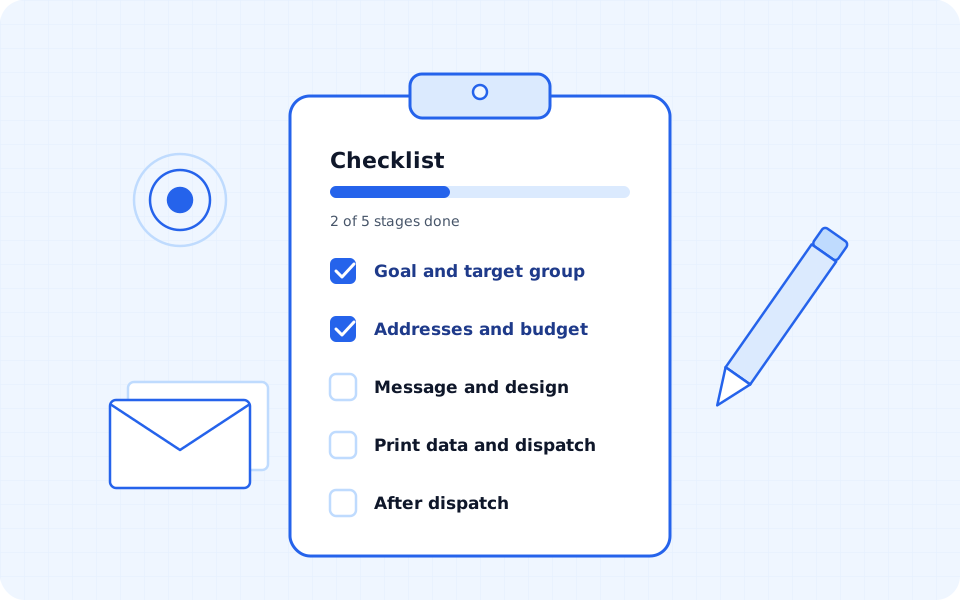
If you want to start with a complete text, choose an advertising letter template. The general checks before approval are in the direct mail checklist, the technical steps under Mail merge with a CSV address list.