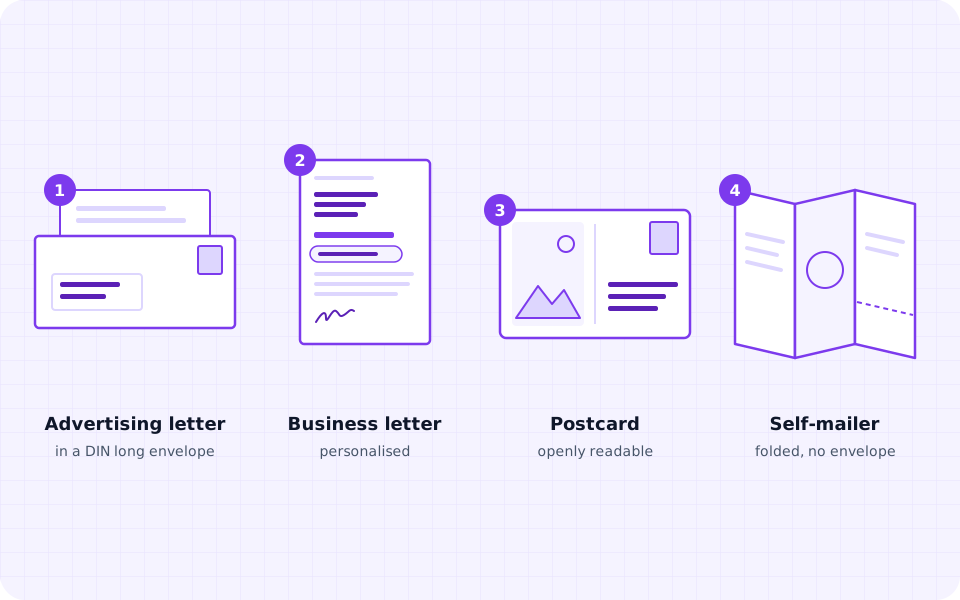
The format decides how much space your message has, how the recipient first perceives it and what the campaign costs. Comparing the common direct mail formats helps you make this decision before copy and design begin.
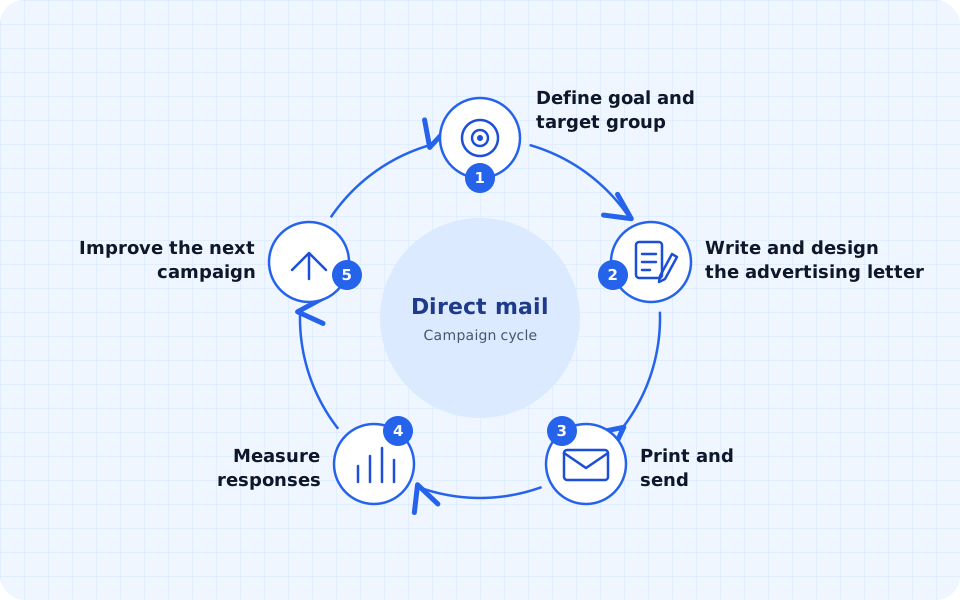
How format choice, target group, copy and measuring success fit together is shown in the overview Direct mail: planning, design and dispatch.
Mailing formats at a glance
| Format | Strengths | Limits | Suited for |
|---|---|---|---|
| Advertising letter in an envelope | plenty of space for arguments, personally addressed, content protected | has to be opened first | offers that need explaining, new and existing customers |
| Personalised business letter | looks like familiar business post, factual, confidential | little room for design, the text has to convince | business customers, contract customers, notices with an offer |
| Postcard and maxi postcard | readable at once, image in the foreground, no need to open | little space, content visible to everyone | invitations, reminders, short promotions, thanks |
| Self-mailer | plenty of surface, reply section possible, no envelope | more complex production, folding and postal requirements | product presentations, promotions with a reply |
The classic advertising letter
The classic advertising letter consists of one or more sheets in an envelope, often supplemented by enclosures such as a brochure or a reply card. It offers the most space for arguments and is personally addressed. Because the content stays hidden, it also suits offers with prices or personal details.
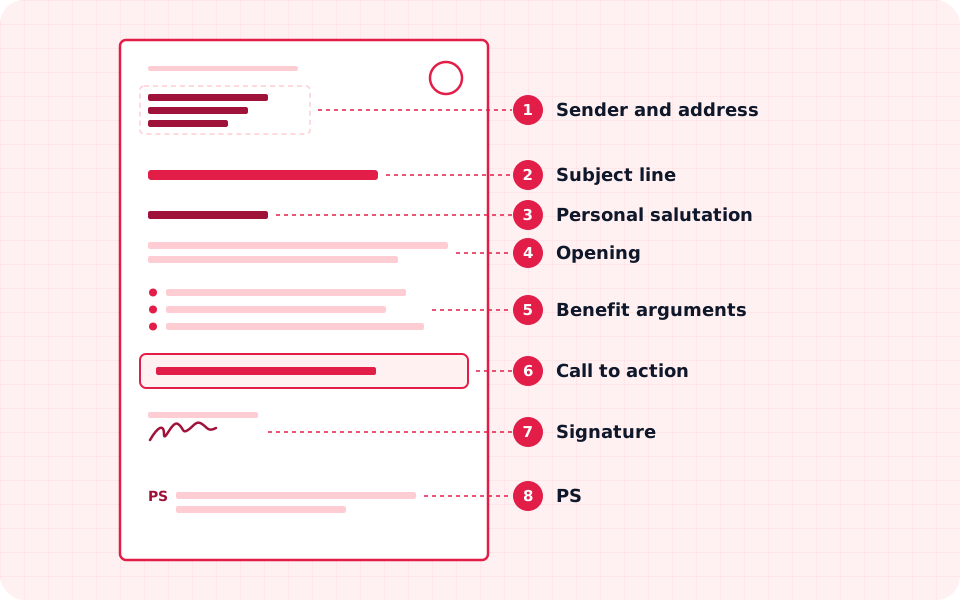
The hurdle is opening it. A recognisable sender and a properly addressed envelope give the recipient a reason to do so. In the letter itself, the subject line, the opening and a clear call to action count. How to build these parts is explained in the guide Writing an advertising letter.
Personalised business letter
The personalised business letter is the plain variant: a letter in the style of normal correspondence, structured under DIN 5008, with a salutation, a signature and no conspicuous advertising design. It is perceived more as a message that concerns the recipient personally and less as advertising.
That suits business customers and existing customers to whom you explain, for example, a contract change and make a fitting additional offer at the same time. Because the design recedes, the subject line, the text and a contact person with a direct dial number carry the effect.
Postcard and maxi postcard
Postcards are sent without an envelope. The recipient sees image and message as soon as they pick up the post. The maxi postcard is larger and offers more surface for image and text.
The strength is also the limit: the text has to work in a few sentences, and everything can be read openly, including by flatmates or colleagues. Confidential content, contract details or personal prices do not belong on a card. Invitations, appointment reminders, a thank-you after a purchase or a promotion that can be explained in one sentence suit it well.
Dimensions and postage for postcards are set by Deutsche Post. The current prices for letters and postcards are in the guide Letter postage 2026.
Self-mailer
A self-mailer is a folded mailing without an envelope. The paper itself carries the address and franking, the content is inside. Depending on the fold, several pages result, over which an offer can unfold step by step. A tear-off reply section, such as a coupon or a reply card, can be built in directly.
Compared with the postcard, the self-mailer offers more space; compared with the letter, the envelope and the enveloping are no longer needed. In return, production is more demanding, because the fold, closure and address field have to match the requirements of the post.
Creating a self-mailer: what to clarify with the print shop
- Fold type: for example C-fold, zigzag fold or gate fold. It determines in which order the reader sees the pages.
- Paper: sturdy enough to survive the journey through the post without an envelope.
- Closure: adhesive dots or sealing labels so that the mailing does not open in transit.
- Address field and franking: position, size and legibility for machine processing.
- Dimensions and weight: They decide the postage band. Check the current requirements of Deutsche Post before printing.
- Reply section: perforation, space to fill in and, if wanted, franking for the reply.
- Sample: Ask for a folded sample before the print run.
Design options
Besides the format, other decisions influence how a mailing works:
- Envelope: size, with or without a window, colour and print.
- Paper: thickness, surface and texture. Heavy paper feels more premium but weighs more.
- Colour: used deliberately for the logo, highlights and images instead of everywhere.
- Enclosures: brochure, reply card, product sample or voucher as a separate element.
- Finishes: embossing, varnish or die-cutting for special occasions.
When sending online with briefsenden, the envelope (DIN long with a window) and the paper are fixed, enclosures are not possible. You can design the letter yourself: colour or black and white, logo, images and a QR code, in the editor or in your own PDF.
Cost factors
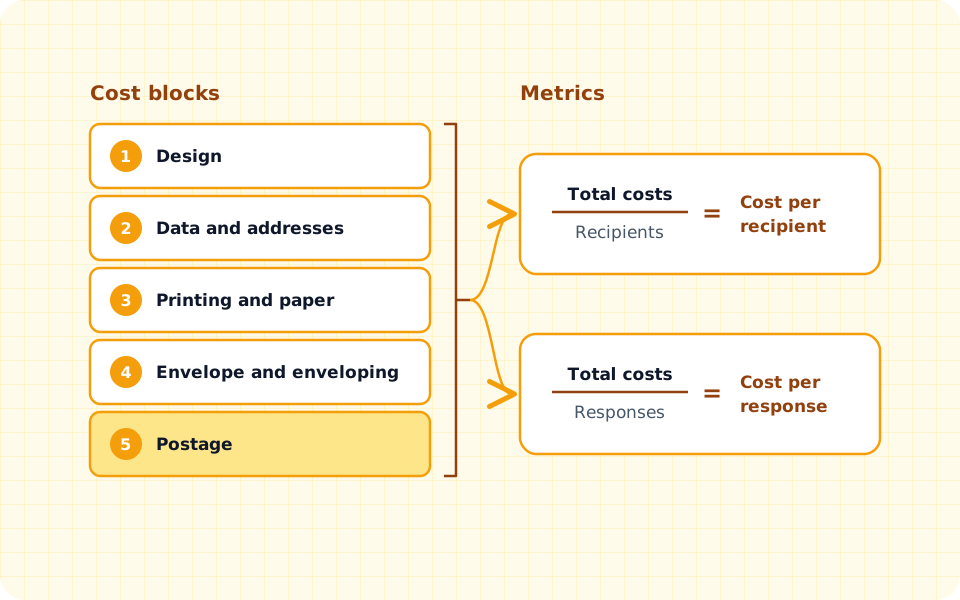
Which format is cheaper depends on several cost blocks:
- Postage: Format, dimensions and weight determine the letter type. A standard letter costs €0.95 with Deutsche Post in 2026, larger or heavier items cost more. For large advertising print runs there is the Dialogpost tariff with minimum quantities.
- Printing: colour, number of pages, paper and print run.
- Materials and finishes: envelopes, enclosures, special papers.
- Assembly: folding, enveloping, inserting enclosures, addressing and franking.
- Preparation: copy, design, addresses and coordination with the print shop or lettershop.
A cheap format is not automatically the more economical one. What counts is what a response costs. How to set up and calculate the budget is shown in the guide Costs of a direct mail campaign.
Decision aid: which format fits?
The starting point is the goal of the campaign. This assignment helps with the first selection:
| Goal | Suitable format |
|---|---|
| Present an offer that needs explaining | Advertising letter in an envelope |
| Address business customers in a factual way | personalised business letter |
| Inform existing customers and make an offer | personalised business letter |
| Invite to an appointment or remind of it | Postcard or advertising letter |
| Draw attention to a short promotion with a strong image | Postcard or maxi postcard |
| Plenty of surface and a reply without an envelope | Self-mailer |
| State prices, contract details or personal information | Letter in an envelope |
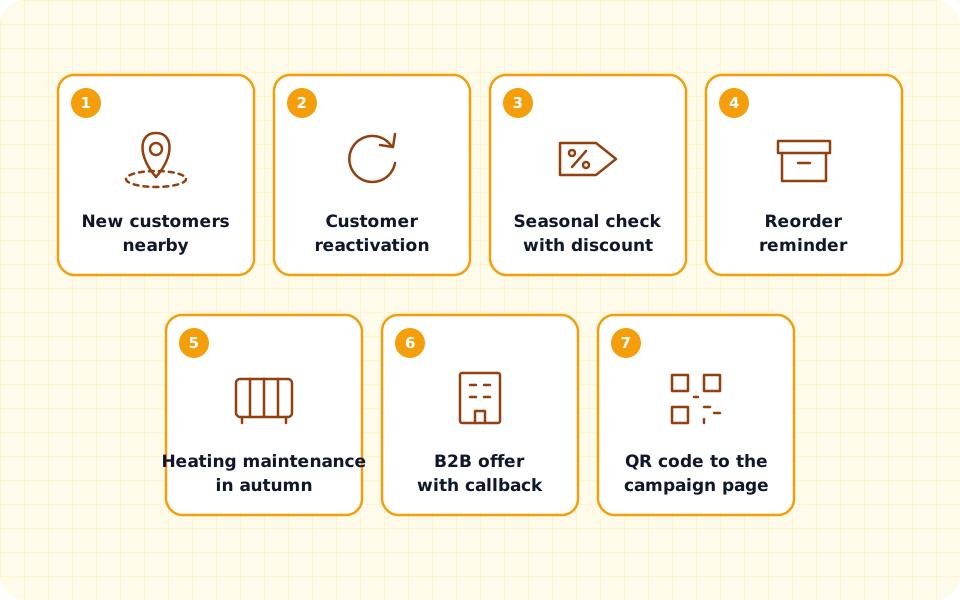
Three questions help in addition: How much does the reader need to know in order to respond? May everyone read along? And how much effort can you put into production and dispatch? How format, occasion and goal can fit together is shown by the invented scenarios in the direct mail examples.
Which formats briefsenden sends
briefsenden.com sends letters: you upload an A4 PDF or design the letter in the editor. briefsenden prints it in black and white or colour, single-sided or double-sided, envelopes it in a DIN long envelope with a window, franks it and hands it over to Deutsche Post. That makes the service suitable for the advertising letter and the personalised business letter, also as a mail merge to many recipients.
| Letter type | Sheets | Price per letter |
|---|---|---|
| Standard letter | 1–3 sheets (double-sided 1–6 pages) | from €0.91 |
| Compact letter | 4–9 sheets (double-sided 7–18 pages) | from €1.28 |
| Large letter | 10+ sheets (double-sided 19–188 pages) | from €2.23 |
Prices in black and white, single-sided, at the best coin rate, including printing, envelope and postage. A letter can comprise up to 94 pages printed single-sided or 188 pages printed double-sided. You will find all variants and the calculator on the pricing page.
The tariff does not change the format: for larger advertising print runs, Dialogpost comes into question. The costs and minimum quantity are explained in the cost guide; you send smaller print runs as a mail merge.
Not on offer: briefsenden does not send postcards, maxi postcards and self-mailers, nor enclosures or special formats. For these formats, contact a print shop or a lettershop.