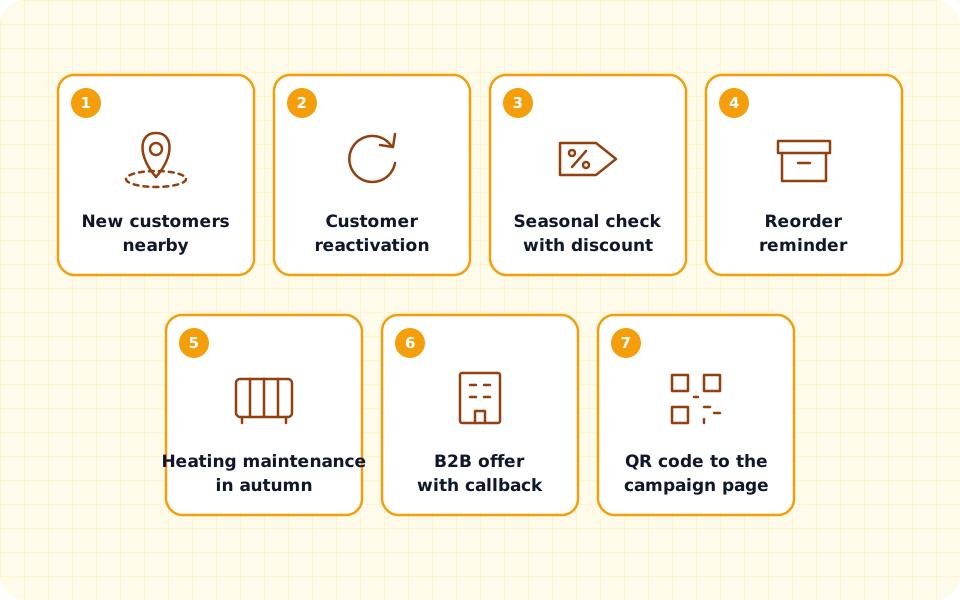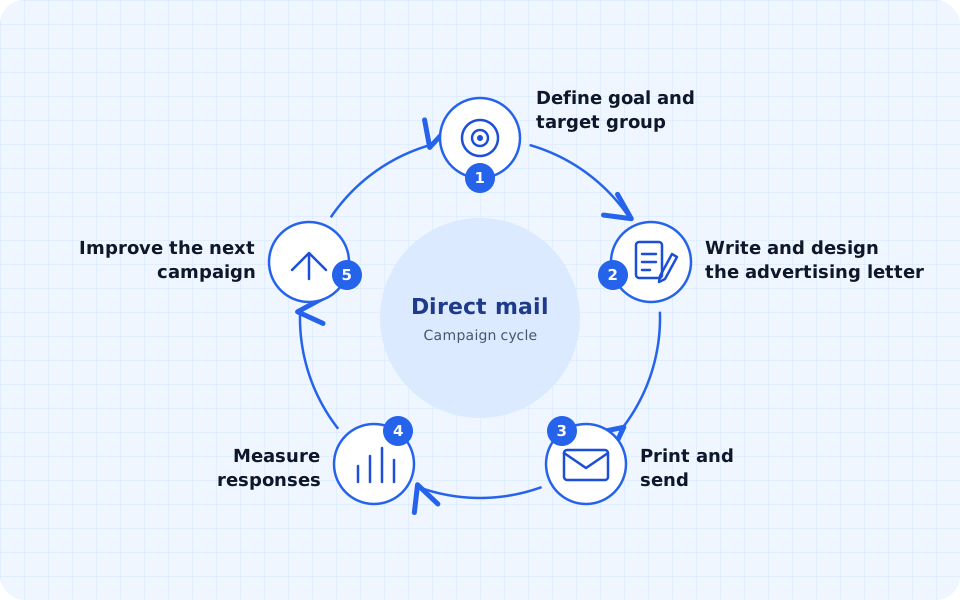
Good direct mail occasions answer the question every recipient asks when opening a letter: why am I getting this letter right now? Anyone with a good answer to that needs less sales language. How a mailing is built overall is explained in the direct mail guide.
When an advertising letter has a good occasion
Not every date in the calendar carries a letter. A good occasion for an advertising letter meets three conditions:
- Understandable: The recipient understands without explanation why you are writing, for example because their maintenance is due or a new product fits their last purchase.
- Well timed: The letter arrives before the decision is made, not after. An offer for garden furniture in September arrives too late.
- Relevant to the recipient: The occasion concerns them, not just your business. A company anniversary only becomes interesting once the customer gets something out of it.
If one of the three points is missing, the letter feels arbitrary. It then helps to sharpen the occasion or to narrow the recipient list down to the customers for whom it really applies.
Seasonal occasions through the year
A seasonal mailing campaign follows the calendar. The table collects mailing ideas for private and business customers. Read the columns as inspiration, not as a fixed assignment.
| Period | Occasion | Idea for B2C | Idea for B2B |
|---|---|---|---|
| January | Start of the year | Look back on the customer year with a benefit for the first purchase | Offer an annual review meeting, present terms for the new year |
| February | Valentine’s Day, end of winter | Gift ideas with a clear order deadline | Offer training dates for the spring |
| March, April | Start of spring, Easter | Season start for garden, bicycle or fashion | Invitation to the trade fair stand or to an appointment on site |
| May, June | Mother’s Day, Father’s Day, start of summer | Gift ideas, present the summer range | Half-year review, offers before the holiday season |
| July, August | Summer holidays | Holiday services such as plant or pet care, holiday courses | Quiet weeks for maintenance, conversion work or training |
| September | Back to school, start of autumn | School supplies, autumn check for home and vehicle | Raise budget planning for the following year |
| October, November | Heating season, start of the pre-Christmas period | Maintenance appointments, announce gift ideas early | Remaining budgets, year-end orders, in-house trade show |
| December | Advent, Christmas, year-end | Thank-you to regular customers, voucher for the new year | Christmas greeting with a review of the year, appointment offer for January |
Watch out for school holidays and bridge days. They fall at different times depending on the federal state, and during this time a letter can lie unread until the campaign is over.
The turn of the year
Everyone understands the turn of the year as an occasion. Two directions suggest themselves: looking back with thanks for the cooperation, and looking ahead at what the new year will bring. A New Year letter in January has one advantage: it does not compete with the Christmas greetings that arrive in December.
New services, changed terms or a benefit for the first order of the year fit the content.
Product launches
A new product carries a letter if it fits the recipient. So do not write to all customers, but to those whose previous purchases fit the new product. The letter explains in one sentence what is new and what it brings the reader. Then it invites them to try it out, for example with a demonstration, a sample or a trial period.
Early access for existing customers turns the announcement into a benefit. Announce new products only once they can be delivered.
Anniversaries
- Company anniversary: Briefly tell what has happened over the years and thank the customers who contributed to it. An anniversary offer gives the letter a reason to act.
- Customer anniversary: A personal thank-you on the anniversary of the first order shows that you know the customer. For this you need the date of the first purchase in your data.
Customer reactivation by letter
Customers who have not ordered for a while already know your business. A customer reactivation letter reminds them of it and gives a reason to come back. When a customer counts as inactive depends on the usual buying rhythm: earlier for consumables than for larger purchases.
- State what has changed since the last purchase: new range, new service, better delivery terms.
- Do not assume a reason for the break.
- Give a time-limited incentive for the next order.
- Offer an easy way back: phone number, short campaign URL or QR code.
Anyone who does not respond to several reactivation letters is better put on a rest list. The guide direct mail target groups shows how to find inactive customers in your data.
Customer loyalty
Not every letter has to sell. An advertising letter for customer loyalty strengthens the relationship and prepares the next purchase. Suitable occasions:
- Thank-you: after a larger order or at the end of the year, without sales pressure.
- Status: The customer reaches a new tier in the bonus programme or gets a permanent contact person.
- Service reminder: Maintenance, an inspection, a refill or a contract review is due.
Events and invitations
An invitation by letter can feel more binding than a post online. Occasions are an open day, an in-house trade show, an opening, a workshop, a talk or a customer evening. The invitation should contain date, time and place, the programme in a few points, how to register with a deadline, and a contact person.
Send the invitation early enough that the recipients can keep the date free. With Dialogpost, allow for delivery in 3–5 working days. A reminder shortly before the date can go by email to everyone who has registered.
Special offers
A special offer needs a reason, otherwise it looks like a permanent discount. Reasons are a change of season, a stock clearance, an opening, an anniversary or a benefit for existing customers only.
- State a deadline with a date instead of “for a limited time only”.
- Build the postal transit time into the deadline.
- State conditions openly, such as a minimum order value or excluded items.
- Make the benefit measurable, for example with a promotion code just for this letter.
Price changes
A price increase is also an occasion for a letter, though a delicate one. When it is justified factually and announced early, it is easier to understand. State the new price, the date and the reason in clear words. Show what the customer continues to get or what is added, and name a contact person for questions.
For ongoing contracts, contractual deadlines and formal requirements apply to price changes. Check these in the individual case before you send the letter.
Business changes
Changes in your own business affect customers directly:
- a move or new location, with directions and an opening offer
- a new contact person, with a short introduction and a direct extension number
- changed opening or service hours
- a change of range, such as a product being phased out and its successor
Such letters are information and advertising at the same time. Put the information first and keep the offer short.
Occasions in B2B business
Business customers follow cycles of their own. A letter works if it fits into the flow of their decisions:
- Budget planning: When your customers plan the following year, an offer with a contact person can find its way into that planning.
- Maintenance intervals: Inspections and maintenance follow fixed deadlines. A reminder before the date is service.
- Trade fair: beforehand the invitation to the stand, afterwards a letter to the people you spoke to.
- Contract renewal: in good time before expiry, remind them of the services and offer terms.
- Certification: A new qualification shows what your business can now additionally deliver.
Annual planning for mailing campaigns
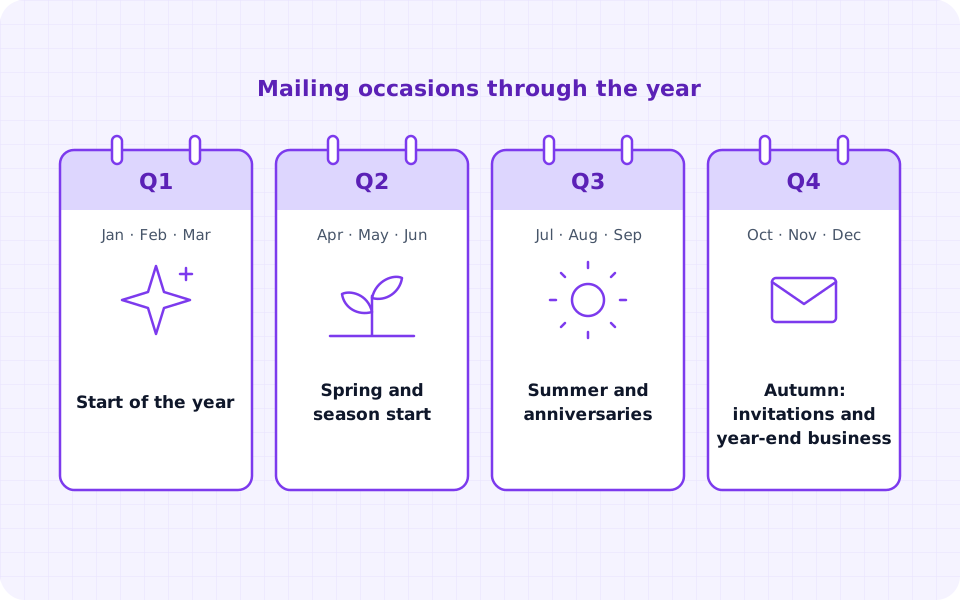
Anyone who plans the direct mail occasions of a year early can prepare copy, addresses and budget in peace. The table shows a simple division by quarter.
| Quarter | Focus | Lead time note |
|---|---|---|
| 1st quarter | Start of the year, review, reactivation after the festive period | Prepare copy and addresses in December, send after the festive period |
| 2nd quarter | Season start, product launches, trade fairs | Announce new products only when they can be delivered, mind the Easter holidays |
| 3rd quarter | Summer offers, anniversaries, maintenance before the heating season | Mind the summer holidays in each federal state, prepare autumn promotions in August |
| 4th quarter | Invitations, budget planning in B2B, year-end business, thank-you | Send Christmas offers early, allow for 3–5 working days of delivery with Dialogpost |
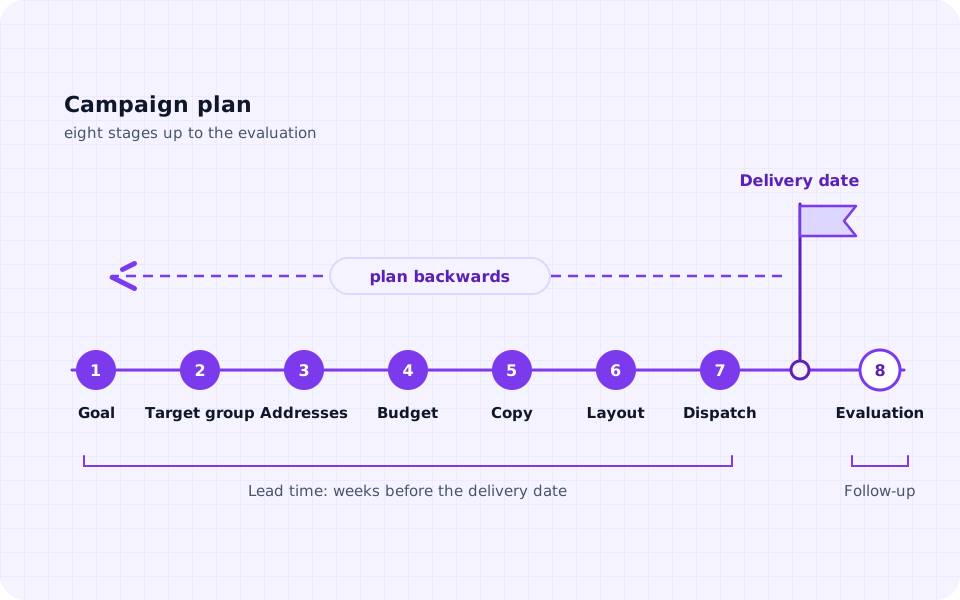
For each individual campaign, count backwards from the desired delivery day. The guide planning a direct mail campaign shows how. What campaigns for such occasions can look like in concrete terms is shown by the direct mail examples.
Preparing occasion mailings with briefsenden
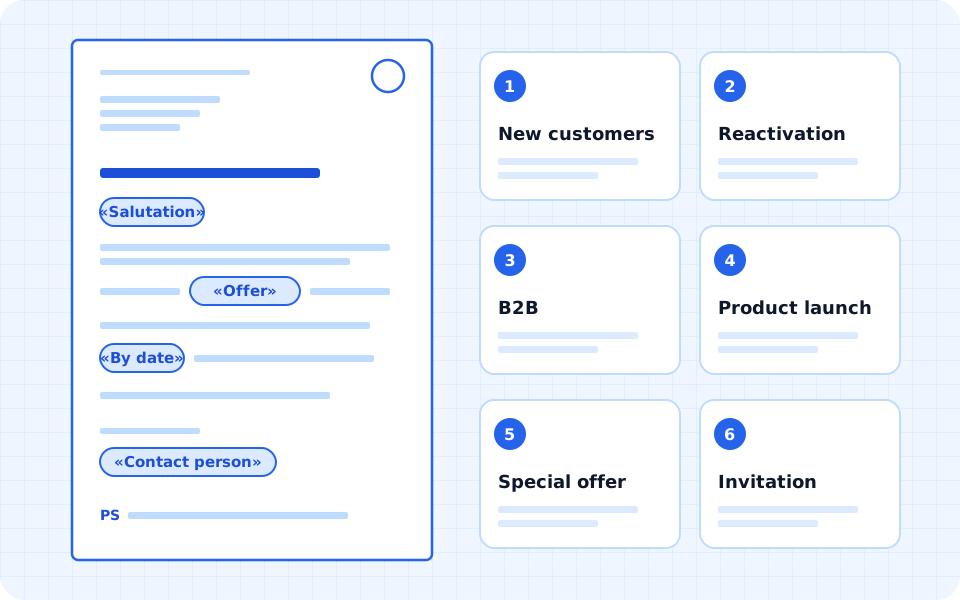
Save recurring occasion letters as a template and adjust the date and offer at the next occasion. For typical occasions you can start with the advertising letter templates. How to coordinate lead time, approval and dispatch date is shown by the campaign planning with a timeline.
The technical dispatch of your recipient list is explained by mail merge with a CSV address list. If every letter contains its own anniversary date or an individual code, prepare the individual letters beforehand as a combined PDF.