
Sending payment reminders by post
Deliver payment reminders quickly, reliably and traceably via Deutsche Post – individually, as a mail merge or automated via API.
- Mail merge for entire dunning runs
- Einschreiben Einwurf or Rückschein
- API integration
Common problems when sending reminders
Late payment is one of the biggest cash flow risks for businesses. Studies show that late payments can account for 2–5% of total receivables. The longer a claim remains outstanding, the lower the likelihood that it will be paid in full.
Sending reminders manually makes this problem worse: printing, enveloping, franking, taking them to the post office – that takes several minutes per reminder. With a dunning run of 50 or 100 reminders, sending is delayed by hours or even days. This delay costs real money.
At the same time, the legal requirements are rising: for court dunning proceedings (gerichtliches Mahnverfahren), the creditor must be able to prove that the reminder was received. A simple letter without proof of delivery is often not enough. If you want to be on the safe side, you need registered mail (Einschreiben) – which makes the trip to the post office even more time-consuming.
Sending payment reminders online: three ways
With briefsenden you send payment reminders straight from your browser – no printer, envelopes or trips to the post office. Three routes are available:
- DashboardUpload and send individual reminders manually – ideal for a few reminders a week.
- Mail mergeUpload a CSV file with recipients and send all reminders of a dunning run at once.
- APIAutomate sending reminders directly from your accounting software – the reminder goes out as soon as an invoice becomes overdue.
All reminders are printed and handed over to Deutsche Post on the same working day. In the dashboard you can see the status at any time – from printing to handover to Deutsche Post. You send the invoices themselves the same way: Automate invoice sending.
Send a reminder in 3 steps
- 1
Upload the reminder as a PDF
Upload your reminder as a PDF – individually, or several reminders as a mail merge via CSV upload with individual recipient addresses.
- 2
Choose recipient & delivery type
Enter the address or import a list of recipients. Choose between standard letter, Einschreiben Einwurf or Einschreiben Rückschein.
- 3
Order the dispatch
Check the preview, confirm the costs and order the dispatch. We print, envelope and hand over to Deutsche Post – on the same working day.
The three-stage dunning process
Professional credit control usually works with three reminder stages. briefsenden supports each stage with the right delivery type:
- 1
1st reminder (payment reminder)
A friendly reminder of the outstanding payment. Usually 7–14 days after the due date. A standard letter is sufficient.
Standard letter
- 2
2nd reminder
A more insistent request referring to the consequences of default and setting a deadline. Recommendation: Einschreiben Einwurf for proof of delivery.
Einschreiben Einwurf recommended
- 3
3rd reminder (final reminder)
Final reminder before legal action is taken. Notice of debt collection or court dunning proceedings. Einschreiben with Rückschein for complete documentation.
Einschreiben Rückschein recommended
Benefits of sending reminders online
- Mail merges for entire dunning runs via CSV
- Registered mail (Einschreiben) with proof of delivery
- API integration with dunning software
- As Einschreiben with a tracking number for the delivery receipt
- Delivery status of every reminder in the dashboard
- Cheaper coins with larger top-ups
- Test mode to check before sending
- GDPR-compliant with a data processing agreement
Reminders and default: legal framework
§§ 286–288 BGB – default (Verzug)
Under §286 BGB (German Civil Code), a reminder puts the debtor in default. For payment claims, default occurs no later than 30 days after the due date and receipt of the invoice (§286(3) BGB). Once the debtor is in default, the creditor can claim default interest under §288 BGB – 5 percentage points above the base rate for consumers, 9 percentage points for businesses.
Proof of receipt & burden of proof
The creditor bears the burden of proving that the reminder was received. A simple letter offers no proof of receipt. An Einschreiben Einwurf documents delivery with the date, time and the postal worker’s signature. An Einschreiben with Rückschein additionally provides the recipient’s acknowledgement of receipt. All variants and prices: Send registered mail online.
Reminder deadlines
There are no statutory reminder deadlines – the reminder can be sent as soon as payment is due. In practice, companies usually set a payment deadline of 7–14 days from receipt of the reminder. For the final reminder before legal action, a deadline of at least 10 days is advisable.
Automating reminder sending
With our REST API you integrate sending reminders directly into your accounting software. The automated workflow: invoice becomes overdue → system creates the reminder as a PDF → API call to briefsenden → printing and dispatch on the same day.
Connectable via Zapier/Make: DATEV, lexoffice, sevDesk and more. Or individually via the REST API.
What does a payment reminder by post cost?
What does sending a payment reminder really cost? Compare doing it yourself with briefsenden:
| Item | Do it yourself | briefsenden |
|---|---|---|
| Printing (b/w, double-sided) | €0.05 | included |
| Envelope & enveloping | €0.03 | included |
| Postage (standard letter) | €0.95 | included |
| Working time (avg. 3 min) | €2.50 | – |
| Total per letter | €3.53 | from €0.91 |
Calculation based on average values. Working time calculated at €50/hr gross labour costs. Savings: up to 74% per reminder. All prices by delivery type: Prices for sending letters online.
FAQs on payment reminders by post
Who sends payment reminders by post
Debt collection agencies, property managers and landlords who want to speed up and professionalise their credit control. Accounts departments in SMEs that regularly run dunning runs with dozens or hundreds of reminders.
Tax advisers and bookkeepers who send reminders on behalf of their clients. Freelancers and self-employed people who want to deliver individual reminders quickly and traceably.
Related guides
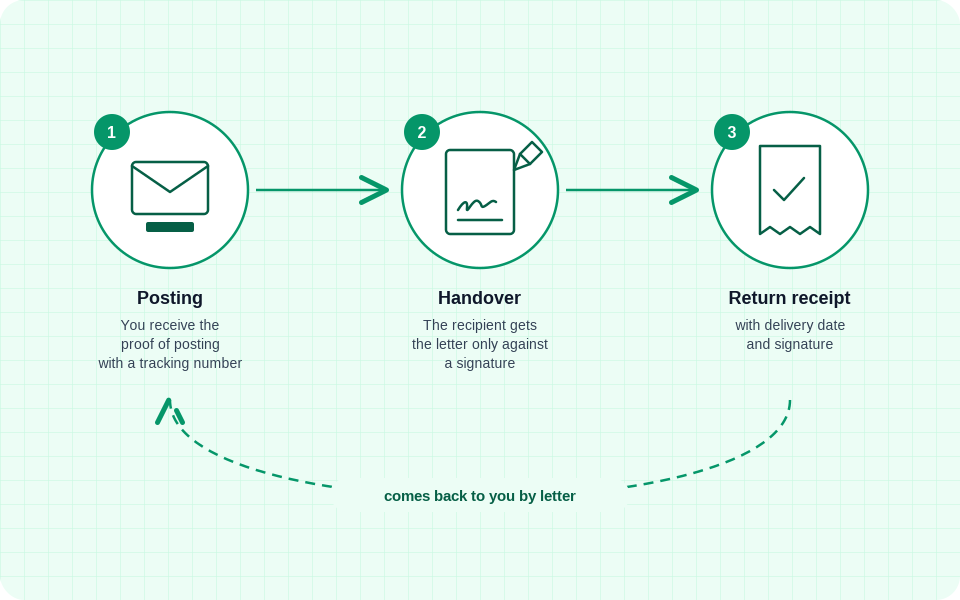
Registered mail with return receipt: process, costs, proof
With registered mail with return receipt, the recipient confirms receipt with a signature, and you get this confirmation back by post. With Deutsche Post this costs €4.85 on top of postage in 2026.
Read more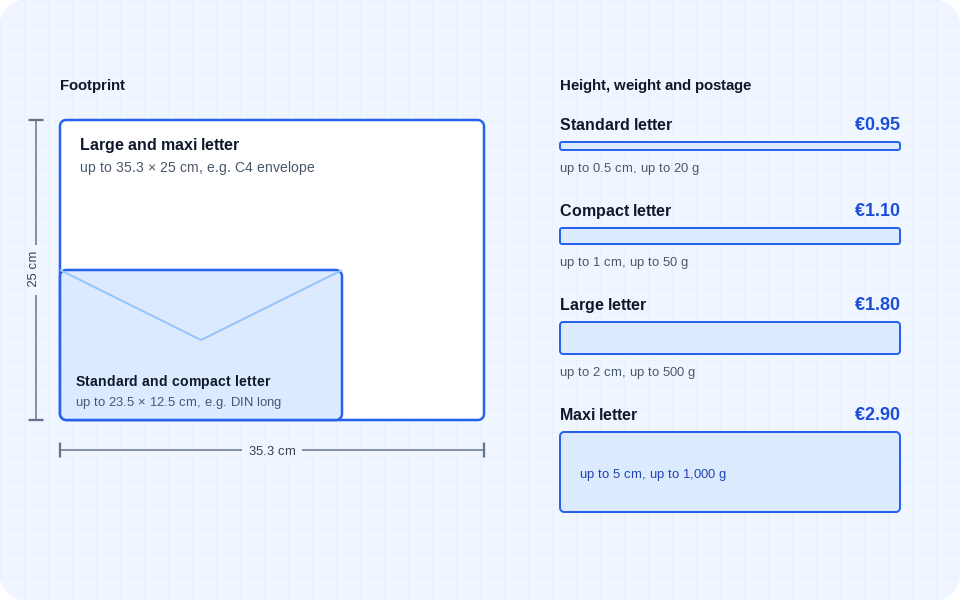
Letter postage 2026: prices, formats and sizes
In 2026 a standard letter and a postcard cost €0.95 with Deutsche Post, the compact letter €1.10, the large letter €1.80 and the maxi letter €2.90. Plus sizes, weight limits and surcharges for registered mail.
Read more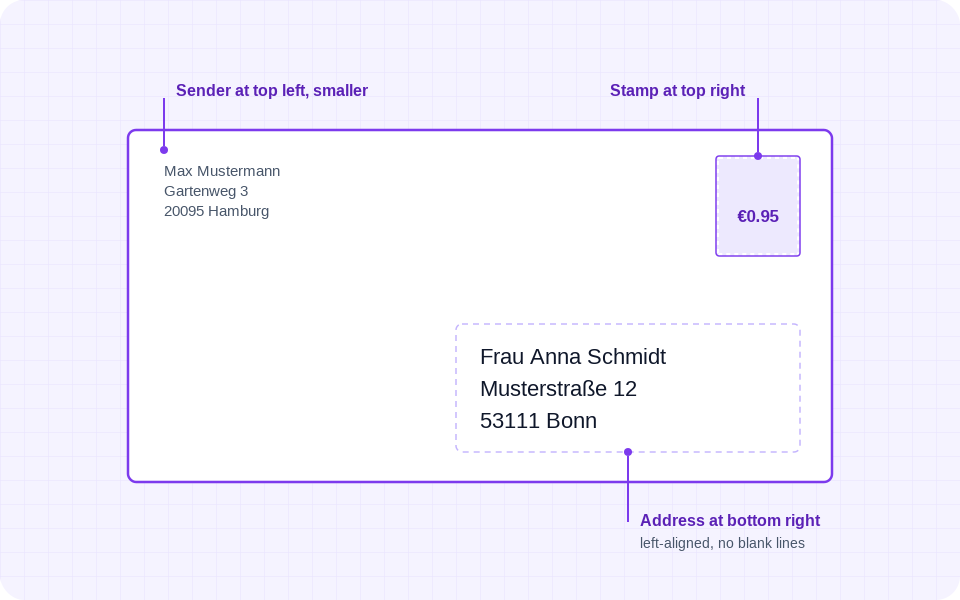
How to address an envelope: sender and recipient
The recipient goes on the front at the bottom right, the sender at the top left, the stamp at the top right. The address follows DIN 5008: name, street and house number, postcode and town, without blank lines.
Read more
Start sending reminders
Create your free account and send your first payment reminder in under 2 minutes.