
Send payslips by post
Payslips by post: you upload the combined PDF from your payroll software, we print, envelope and send each payslip via Deutsche Post, from €0.91 per letter. Confidential in a sealed envelope, for employees without access to a digital mailbox.
- Confidential in a sealed envelope
- Mail merge for bulk dispatch
- Automation via REST API
Why payslips still go by post
Under Section 108 of the German Trade Regulation Act (Gewerbeordnung, GewO), every employer must give its employees a payslip in text form. Since a ruling by the Federal Labour Court (Bundesarbeitsgericht, 28 January 2025, 9 AZR 48/24), a digital employee mailbox is generally sufficient for this. But not every company has a payroll portal, and not all employees can reach one: staff without a work computer, temporary workers or former employees receive their payslip by post as before.
For payroll bureaus and HR departments this means: every month, dozens or hundreds of payslips have to be printed, put into envelopes, franked and taken to the post office. For a tax adviser with 20 clients and an average of 30 employees per client, that is 600 letters a month – a considerable amount of time.
On top of that, the data is particularly sensitive: payslips contain personal and financial information that must be treated confidentially. Sending them open or handling them improperly can lead to GDPR breaches.
Having payslips printed and sent
With briefsenden you send payslips straight from your browser – without a printer, envelopes or franking machine. Export the payslips from your payroll software as a PDF, upload them to briefsenden and order the dispatch.
For the recurring monthly run, use the "Split PDF" mail merge : upload the combined PDF, check the extracted addresses, start sending. Via our REST API the entire process can also be controlled fully automatically from your payroll software – without manual intervention.
Payslips by post in 3 steps
- 1
Export a combined PDF
Export the month’s payslips from your payroll software as one PDF file. Each payslip has the same number of pages and the employee’s address in the address field for the window envelope.
- 2
Split and check
In the "Split PDF" mail merge, briefsenden detects the pages per letter from the addresses, splits the file into individual letters, reads the address of each payslip and shows them to you for checking before you start.
- 3
Order dispatch
Check the preview and start sending. We print every payslip, send it in a sealed envelope and hand it to Deutsche Post.
Typical payroll documents
Monthly payslip
Salary statements with gross/net pay, deductions and employer contributions – confidential in a sealed envelope.
Annual social security notification
Annual social security notification to all employees.
Income tax certificate
Electronic income tax certificate as a printout for employees who do not want digital access.
Social security record
Notifications and records for the social security institutions, sent to employees.
Certificates
Employment certificates, earnings certificates and other HR documents by post.
Benefits of sending payslips online
- Mail merge for monthly bulk dispatch
- Address read automatically from every payslip
- Automation via REST API
- Confidential dispatch in a sealed envelope
- Dispatch status of every payslip in the dashboard
- Test mode to check before sending
- GDPR-compliant with a data processing agreement
- Up to 74% cheaper than doing it yourself
Payslips: GewO, Evidence Act, GDPR
GewO §108 – obligation to provide payslips
When paying wages, the employer must give the employee a payslip in text form. The payslip must at least state the pay period, the composition of the pay and the deductions. With briefsenden you deliver the payslips by post.
Evidence Act (Nachweisgesetz)
The Evidence Act requires employers to record the essential terms of employment in writing. Changes to the working conditions must also be communicated to the employee in writing.
GDPR and salary data
Payslips contain personal data that is particularly worthy of protection. briefsenden processes it on the basis of a data processing agreement (DPA). The letter contents are processed exclusively on servers in Germany and deleted automatically 30 days after dispatch.
Integration with payroll software
briefsenden can be integrated into your existing payroll software via the REST API. The automated workflow: your software creates the payslip PDFs, passes them to briefsenden via the API, and we take care of printing and dispatch.
Can be connected via Zapier/Make : DATEV, Lexware, Agenda and more. Or individually via the REST API.
What does a payslip by post cost?
What does it cost to send a payslip? Comparison for 100 payslips per month:
| Item | Do it yourself | briefsenden |
|---|---|---|
| Printing (b/w, double-sided) | €0.05 | included |
| Envelope & enveloping | €0.05 | included |
| Postage (standard letter) | €0.95 | included |
| Working time (avg. 3 min) | €2.50 | – |
| Total per letter | €3.55 | from €0.91* |
For 100 letters/month: doing it yourself approx. €355, briefsenden €101.86 with a monthly top-up. Savings: at least €253/month or over €3,000/year. All prices per dispatch type: Prices for sending letters online .
* At the best coin rate (1.00 ct per coin with a top-up from €250); with smaller top-ups the coin price is higher.
FAQs on payslips by post
Who sends payslips by post
Payroll bureaus and tax advisers handling payroll for clients who have to send payslips for several clients every month. HR departments in medium-sized companies that still inform some of their employees by post.
Particularly suitable for companies with employees in production, skilled trades or field service who have no regular access to digital portals and want to receive their payslips by post.
Related guides
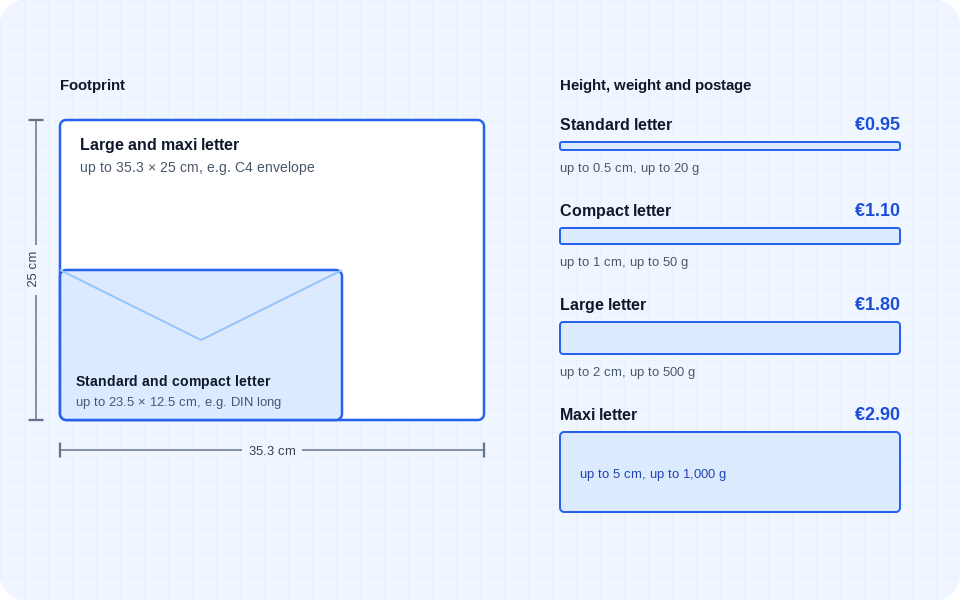
Letter postage 2026: prices, formats and sizes
In 2026 a standard letter and a postcard cost €0.95 with Deutsche Post, the compact letter €1.10, the large letter €1.80 and the maxi letter €2.90. Plus sizes, weight limits and surcharges for registered mail.
Read more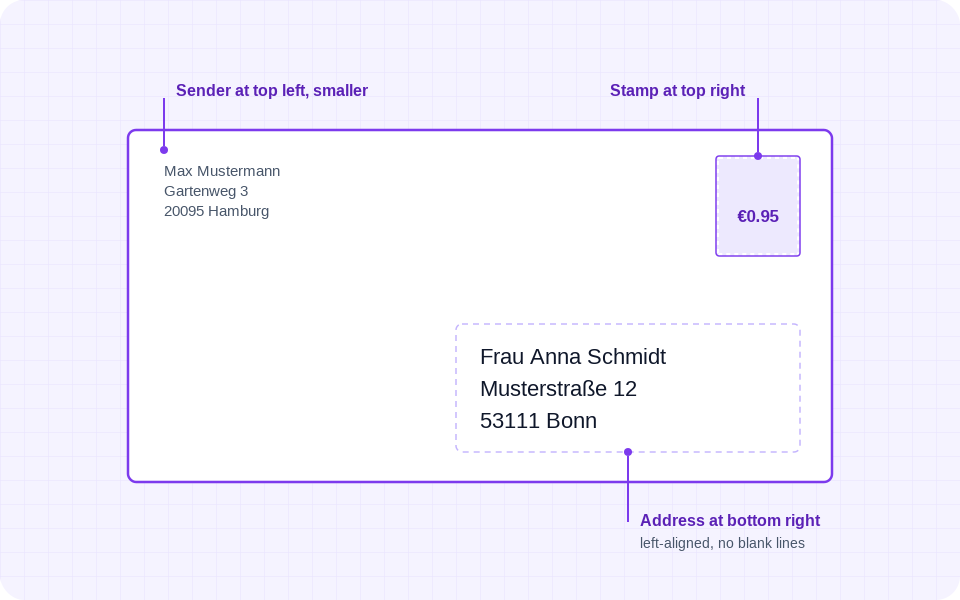
How to address an envelope: sender and recipient
The recipient goes on the front at the bottom right, the sender at the top left, the stamp at the top right. The address follows DIN 5008: name, street and house number, postcode and town, without blank lines.
Read more
Send payslips
Create your free account and send your first payslips in under 5 minutes.